AI estimate as of October 4, 2025 · verify with a professional before acting
AI-Generated · Verify before acting
Everything on this page is generated by AI for informational purposes only. AI can make mistakes — the AI may misidentify items or misattribute them (artist, maker, brand, designer, origin, era). This is not an official valuation and should not be used for insurance, sale, tax, estate, legal, or lending purposes — or any decision requiring a certified appraisal. It is not an authoritative claim about any person, brand, or rights holder — do not share or rely on it as a factual statement about a third party. Always consult qualified professionals before making financial decisions.
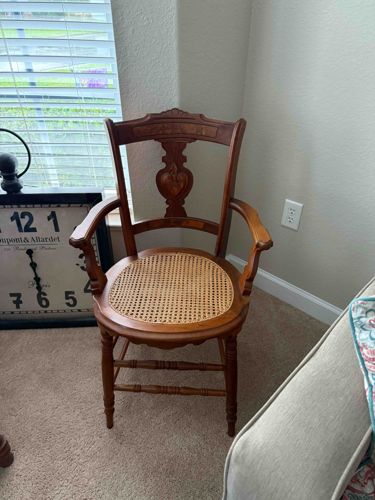
This appears to be a vintage armchair, likely crafted from a medium-toned hardwood such as oak or maple, presenting a warm, reddish-brown stain with a semi-gloss finish. The chair features an elaborately carved backrest, with a top rail exhibiting a central scrolling motif flanked by smaller volutes, and a prominent heart-shaped or shield-like pierced splat below, detailed with additional floral or organic carvings. The arms are gently curved, terminating in rounded handrests that show some evidence of wear or darkening from use. The seat is a traditional woven cane panel, indicating a classic construction method known for its breathability and subtle flexibility. The legs are turned, tapering slightly, and connected by turned stretchers for added stability, with two front stretchers and a single stretcher on each side. The overall construction suggests a robust and well-made piece of furniture, designed for both comfort and aesthetic appeal. Given the styling of the carved back and turned elements, this chair likely dates from the late 19th to early 20th century, possibly in the Victorian or Arts and Crafts revival style. Condition-wise, the cane seat appears intact with good tension, though a closer inspection would be needed to rule out any minor breaks. The wooden frame shows a consistent patina, with some light scuffs or minor dents expected from age and use, particularly around the edges and on the armrests. There are no immediately visible major damages, repairs, or significant cracks, suggesting it has been well-maintained. The craftsmanship is evident in the detailed carvings and the precise joinery of the turned components, indicating a quality piece of furniture from its era. This chair would function as a side chair, occasional chair, or a desk chair.
AI Appraisal Report
Based on my visual examination of the provided image, this Vintage Carved Wood Cane Seat Armchair appears to be a well-preserved example from the late 19th or early 20th century. The medium-toned hardwood, likely oak or maple, exhibits a warm, consistent patina with a semi-gloss finish, suggesting it has been cared for over time. The elaborate carved backrest, featuring a central scrolling motif, volutes, and a prominent heart-shaped pierced splat with floral details, is characteristic of Victorian or Arts and Crafts revival styling. The turned legs and stretchers further support this dating. The woven cane seat appears intact with good tension, which significantly contributes to its value, as cane replacement can be costly. I note minor scuffs and darkening on the armrests, consistent with age and regular use, but no major damages such as cracks, loose joints, or repairs are immediately evident. The craftsmanship in the carvings and joinery indicates a quality production.
In terms of market conditions, vintage armchairs of this style are generally in moderate demand. They appeal to collectors of period furniture or individuals seeking unique accent pieces for eclectic interiors. While not exceedingly rare, the intact cane seat and the detailed carvings elevate its appeal compared to simpler designs. Comparables in good condition typically fetch prices in the range of $250-$400 at auction or specialty vintage furniture stores. Factors impacting this value include the chair's age-appropriate condition, the intricate carving details, and the sound cane seat.
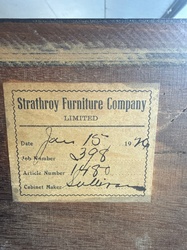
Limitations in authenticity verification from images alone are present. Without physical inspection, I cannot definitively confirm wood species, the extent of any hidden repairs, or the structural integrity of all joints. A hands-on examination would also be necessary to assess the precise type of cane weaving and rule out any minor unseen damage to the cane or frame. Provenance documentation, while helpful for historical context, is not crucial for valuing pieces of this nature, but could add marginal value if available.