AI estimate as of August 11, 2025 · verify with a professional before acting
AI-Generated · Verify before acting
Everything on this page is generated by AI for informational purposes only. AI can make mistakes — the AI may misidentify items or misattribute them (artist, maker, brand, designer, origin, era). This is not an official valuation and should not be used for insurance, sale, tax, estate, legal, or lending purposes — or any decision requiring a certified appraisal. It is not an authoritative claim about any person, brand, or rights holder — do not share or rely on it as a factual statement about a third party. Always consult qualified professionals before making financial decisions.
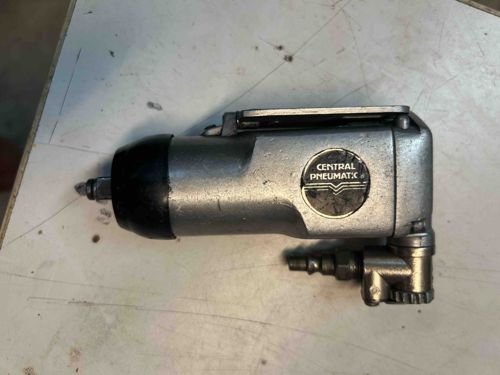
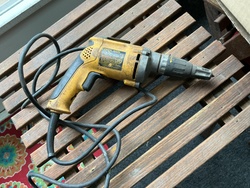
This is a vintage Central Pneumatic 1/2-inch Drive Air Impact Wrench, a robust tool designed for heavy-duty applications. The tool's primary body appears to be constructed from a durable cast metal, likely aluminum or a similar alloy, given its grayish-silver coloration and somewhat textured finish. The front part of the tool, encompassing the anvil and housing, is covered by a black rubber boot or protector which shows some wear, including scuffs and light discoloration. The overall construction exhibits an aged aesthetic, suggesting it is an older model, possibly from the mid-to-late 20th century.
Key features include a prominent circular black and white label adhered to the side, clearly displaying the brand name "CENTRAL PNEUMATIC" with a distinctive stylized 'V' beneath. This label shows signs of wear, including scratches and fading, indicating frequent use. At the rear, there is a brass-colored air inlet fitting, typical for connecting to an air compressor hose. The tool's design includes an integrated handle area, though the actual trigger mechanism is not fully visible, it is implied by the overall form factor.
The visible condition of the impact wrench suggests it has been well-used but maintained. There are scuffs, scratches, and some discoloration consistent with a working tool that has seen various environments. No significant cracks or structural damage are immediately apparent, speaking to the quality of its original construction. The patina on the metal surfaces is typical of an older pneumatic tool, showing signs of oxidation and grime build-up in crevices. The craftsmanship appears sturdy and utilitarian, focused on performance and durability rather than aesthetic refinement. This tool would likely have been part of a professional mechanic's or industrial worker's set.
AI Appraisal Report
Upon examining the provided image of the Central Pneumatic 1/2-inch Drive Air Impact Wrench, I've assessed its condition and potential market value. The tool appears to be a vintage piece, likely from the mid-to-late 20th century, given its construction, cast metal body, and the 'CENTRAL PNEUMATIC' label design. The black rubber boot shows expected wear, including scuffs and light discoloration, consistent with a tool that has seen considerable use. The brass-colored air inlet fitting also aligns with older pneumatic tool designs. While well-used, I see no immediate signs of significant structural damage such as major cracks, which speaks to its original robust construction. The patina, scratches, and grime are typical for such an item and actually contribute to its vintage character, rather than detracting from its functional aesthetic.
From a market perspective, vintage Central Pneumatic tools, particularly impact wrenches, generally appeal to collectors of vintage garage tools, hobby mechanics, or individuals seeking robust, older American-made (or American-marketed) equipment. Demand for these specific vintage Central Pneumatic models is moderate; they are not exceptionally rare, but a well-maintained example can fetch a reasonable price. Comparables for common vintage 1/2-inch air impact wrenches from similar eras (e.g., Ingersoll Rand, Craftsman) in 'used but functional' condition typically range from $30 to $80.
Key factors impacting value include the visible wear on the rubber boot and label, which, while common, slightly diminishes collector appeal for 'mint' condition examples. However, the apparent lack of major damage is a strong positive. Without an in-person examination, I cannot verify its operational functionality (e.g., air leaks, internal mechanism wear, power output). This is a significant limitation, as a non-functional tool would drastically reduce its value. Full authenticity verification, beyond the visual consistency, would require physical inspection of serial numbers (if present), internal components, and material analysis. Provenance documentation would also add significant value.
Given the visible condition, its likely functionality for a collector or light-duty use, and market comparables for similar vintage, used tools, I estimate its value.