AI estimate as of November 4, 2025 · verify with a professional before acting
AI-Generated · Verify before acting
Everything on this page is generated by AI for informational purposes only. AI can make mistakes — the AI may misidentify items or misattribute them (artist, maker, brand, designer, origin, era). This is not an official valuation and should not be used for insurance, sale, tax, estate, legal, or lending purposes — or any decision requiring a certified appraisal. It is not an authoritative claim about any person, brand, or rights holder — do not share or rely on it as a factual statement about a third party. Always consult qualified professionals before making financial decisions.
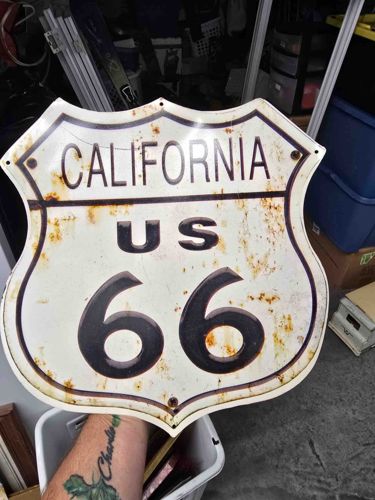
This is a vintage US Route 66 shield sign, specifically indicating 'CALIFORNIA US 66'. The sign is crafted from a metal material, likely porcelain enamel over steel, given the appearance of rust and chipping typical of this manufacturing technique. It features the distinctive shield shape associated with US highway markers. The primary colors are white for the background and black for the lettering ('CALIFORNIA', 'US', and '66') and the border. The sign exhibits significant signs of age and wear consistent with outdoor exposure or prolonged storage in varying conditions. Numerous areas of rust are visible, particularly around the edges, screw holes, and along cracks in the enamel surface, indicating that the protective coating has been compromised. Several small chips and scratches are present, revealing the underlying metal. There are four visible holes, one in each 'corner' of the shield, which would have been used for mounting the sign. The top section, above 'CALIFORNIA', shows a distinct crack or line running horizontally across the white background. The overall condition suggests a genuine vintage piece rather than a modern replica, although without a manufacturer's mark or date, it is difficult to precisely determine its origin or exact age. However, its aesthetic aligns with signs used during the mid-20th century. The quality of the original craftsmanship, though now weathered, would have been durable, designed for public display.
AI Appraisal Report
I have carefully examined the image of this Vintage California US Route 66 Shield Sign. Based on my visual assessment, the sign appears to be an authentic period piece, likely a porcelain enamel over steel highway marker from the mid-20th century. The significant rust, enamel loss, chipping, and visible crack lines are consistent with genuine outdoor exposure and age, rather than artificial distressing. The distinctive shield shape and font style align with historical Route 66 signage. The four mounting holes are also typical for such markers.
The condition, while heavily weathered, contributes to its vintage appeal for many collectors. However, the extent of the rust and enamel loss, particularly around the edges and impact points, does detract from its overall aesthetic preservation. Signs in better, unrestored condition would command a higher premium.
In terms of market conditions, vintage Route 66 memorabilia, especially authentic highway signs, enjoys strong demand among collectors of automobilia, American history, and roadside Americana. The 'California' designation adds a desirable regional specificity. While not exceedingly rare, authentic examples, particularly those that haven't been heavily restored or are not common reproductions, are increasingly sought after. Comparables for similar weathered but authentic Route 66 porcelain enamel signs generally fall within the $700-$1,500 range, depending on condition, specific state, and buyer enthusiasm.
Key factors impacting value here are its authenticity (which appears high visually), the iconic nature of Route 66, and the 'California' state designation. The extensive wear is a double-edged sword; it confirms authenticity but impacts visual appeal.
It is crucial to note that my assessment of authenticity is based solely on visual cues from the provided image. For full verification, a physical in-person examination would be required to assess the weight, thickness, exact material composition, and potential manufacturer’s marks not visible. Provenance documentation, such as where it was acquired or its history, would also significantly bolster authentication. Scientific testing to confirm the age of the enamel could also be performed, but this is usually reserved for extremely high-value or disputed items.