AI estimate as of October 21, 2025 · verify with a professional before acting
AI-Generated · Verify before acting
Everything on this page is generated by AI for informational purposes only. AI can make mistakes — the AI may misidentify items or misattribute them (artist, maker, brand, designer, origin, era). This is not an official valuation and should not be used for insurance, sale, tax, estate, legal, or lending purposes — or any decision requiring a certified appraisal. It is not an authoritative claim about any person, brand, or rights holder — do not share or rely on it as a factual statement about a third party. Always consult qualified professionals before making financial decisions.
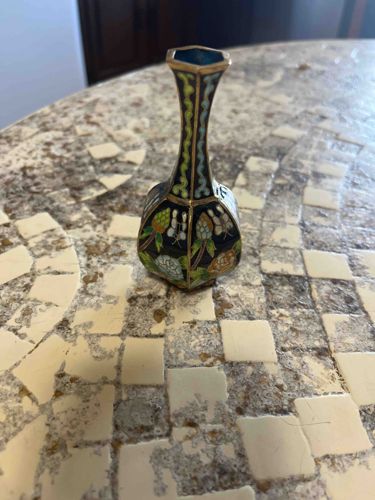
This is a small, ornate cloisonné vase, likely miniature in size given its appearance on what seems to be a tabletop. The vase features a distinctive hexagonal form, both in its base and tapering neck, characteristic of traditional cloisonné craftsmanship. The primary color scheme is dark, likely black or a very deep navy, serving as a rich background for the intricate enamel work. The decoration on the lower, wider part of the vase consists of stylized botanical motifs, possibly depicting flowers, leaves, and butterflies, rendered in a palette of green, white, orange, and light blue enamels. The cloisons, or metal wires that form the outlines of the design, are visible as fine gold-toned lines, creating individual cells for the enamel. The neck of the vase is adorned with a curvilinear, almost flame-like pattern in similar colors, outlined in gold. The rim of the mouth appears to be gold-toned as well, with a bright blue enamel visible on the interior of the opening, suggesting a contrasting interior finish. Dimensions are difficult to ascertain precisely without a reference scale, but its proportions suggest it is a decorative item, possibly for a collection or display. The craftsmanship appears to be of good quality, with precise wire work and smooth enamel application. No significant condition issues like chips, cracks, or substantial enamel loss are visible in the provided image. The style suggests it could be an item from the 20th century, possibly mid to late century, although an earlier origin cannot be entirely ruled out without further hallmarks or historical context. The intricate details and vibrant enamel colors indicate careful artistry and handcraftsmanship.
AI Appraisal Report
Based on my visual examination of the provided image, this Cloisonné Miniature Vase appears to be a decorative item of good quality. The hexagonal form and intricate botanical motifs, outlined in gold-toned cloisons against a dark background, are characteristic of traditional cloisonné work. The enamel colors — green, white, orange, and light blue — are vibrant, and the application appears smooth, indicating careful craftsmanship. I detect no significant condition issues such as chips, cracks, or substantial enamel loss from the image. The gold-toned rim and contrasting blue interior further enhance its visual appeal.
Authenticity: While the craftsmanship suggests a genuine cloisonné piece, it is challenging to definitively confirm its authenticity and precise age from images alone. The style appears consistent with 20th-century Asian, likely mid to late-century, decorative arts. To fully authenticate its origin and age, an in-person examination would be crucial to inspect for maker's marks, the quality of the copper or brass base metal, and the precise firing techniques. Provenance documentation, if available, would also be invaluable. Scientific testing, such as elemental analysis of the enamels, could further confirm its age and materials.
Market Conditions and Demand: Miniature cloisonné vases are generally popular decorative items, often collected. However, without a known prestigious maker or significant age, their value tends to be in the lower to mid-range for decorative arts. Comparable items of this size and quality typically sell within the $100-$200 range in general decorative arts markets or online platforms. Rarity is not a significant factor here, as similar pieces are relatively common.
Factors impacting value: The good condition and intricate handcraftsmanship positively impact its value. However, the lack of definitive age, maker's marks, or provenance, which are not ascertainable from an image, limits its potential for a higher valuation. If it were definitively identified as an antique from a renowned workshop, the value would be considerably higher.