AI estimate as of November 14, 2025 · verify with a professional before acting
AI-Generated · Verify before acting
Everything on this page is generated by AI for informational purposes only. AI can make mistakes — the AI may misidentify items or misattribute them (artist, maker, brand, designer, origin, era). This is not an official valuation and should not be used for insurance, sale, tax, estate, legal, or lending purposes — or any decision requiring a certified appraisal. It is not an authoritative claim about any person, brand, or rights holder — do not share or rely on it as a factual statement about a third party. Always consult qualified professionals before making financial decisions.
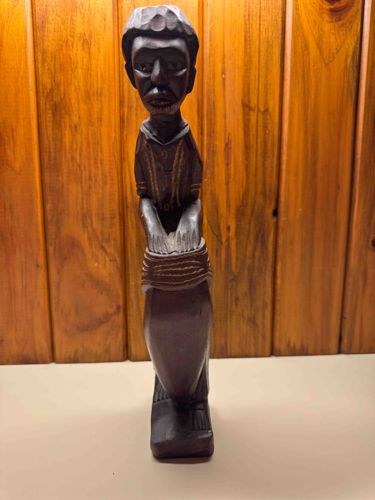
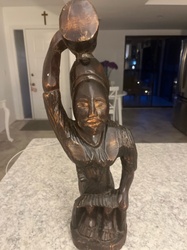
This is a hand-carved wooden figural sculpture depicting a standing man holding what appears to be two drums. The overall color of the carving is a dark, rich brown, suggesting the use of a dark hardwood such as ebony or a similarly dense timber, or possibly stained wood. The figure stands upright on an integrated, rectangular base. The man has distinct facial features, including a prominent nose, deeply set eyes, and a carved beard and mustache. His hair is also carved with a textured, wavy pattern around the top of his head. He is depicted wearing a simple tunic or shirt with carved vertical and horizontal lines suggesting embroidered or woven patterns. Both arms are bent at the elbows, holding two cylindrical objects, likely drums, against his midsection. A notable feature is the detail around the top edge of these cylinders, where carved horizontal lines suggest rope or binding holding drum skins in place, though the 'skins' themselves are carved seamlessly into the wood. The carving exhibits a folk art or tribal aesthetic, characterized by its stylized anthropomorphic form and robust, somewhat angular lines. There are no immediate visible signs of damage such as cracks or chips, and the surface appears to have a subtle sheen, indicating either a natural polish from handling or a protective finish. The craftsmanship suggests a skilled artisan, with attention paid to proportional representation despite its stylized nature. The style period is difficult to ascertain precisely without further context, but it likely dates from the mid-20th century to the present, consistent with tourist art or traditional African art from various regions. The absence of specific maker's marks or signatures is common for this type of folk art.
AI Appraisal Report
Upon examining the images of this African figural carving, I assess it to be a skillfully executed example of 20th-century folk or tourist art. The piece is hand-carved from a dark hardwood, possibly stained to achieve its uniform color, and depicts a man with two drums. The carving technique is competent, with good attention to stylized details on the face, clothing, and instruments. The surface appears to be in very good condition with no visible cracks, chips, or significant abrasions, retaining a consistent finish.
The value of such pieces is largely determined by age, origin, artistic merit, and provenance. Based on the style and finish, this sculpture is most likely a 'tourist art' piece, created for sale rather than for traditional ceremonial use. The market for this type of decorative African art is broad and accessible. Comparable carvings of similar size, quality, and subject matter typically sell in the secondary market for between $75 and $150. Pieces with a more refined artistic execution or those verifiably older can achieve higher prices.
The primary factor limiting the value is its likely status as a decorative or tourist item rather than a ritually used antique artifact. My appraisal is based solely on visual examination of the provided images, which prevents a definitive assessment of age, specific wood type, or origin. A full authentication would require physical inspection to examine tool marks, signs of wear and aging (patina), and the specific characteristics of the wood. Furthermore, provenance documentation linking the item to a specific region, artist, or collection period would be necessary to establish any value beyond its decorative appeal.