Ancient Indo-Greek Silver Drachm of Menander I Soter
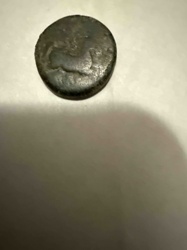
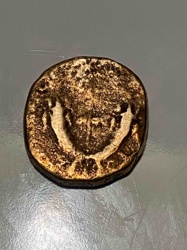
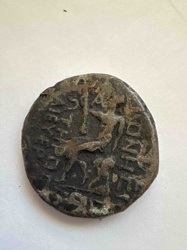
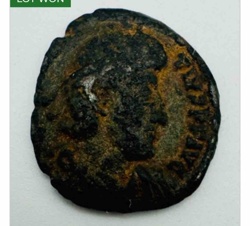
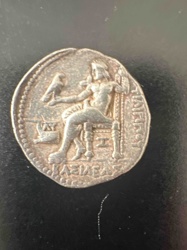
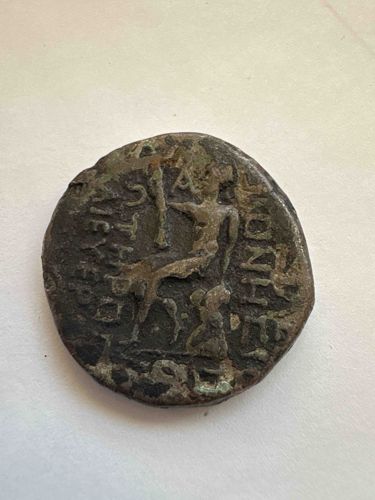
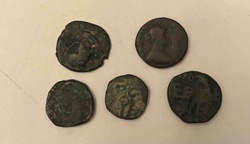
This is an ancient silver drachm attributed to the Indo-Greek King Menander I Soter, who reigned approximately 165/155 to 130 BCE. The coin's reverse side is shown, featuring a stylized standing figure of Athena Alkidemos (Athena, Savior of the People) facing left, holding a thunderbolt and a shield. The coin is struck in silver with a significant dark gray and earthen patina, characteristic of long-term burial. It displays a rough, irregular flan common to the period and regional minting practices. The Greek legend 'BASILEOS SOTEROS MENANDROU' is partially visible in a circular arrangement around the central figure. The condition shows heavy wear on the high points of the relief and significant mineralization on the surface. There are visible encrustations and minor pitting, with some green verdigris spots suggesting slight copper leaching from the alloy. The strike is somewhat off-center, particularly on the left side of the reverse, which has cut off parts of the Greek inscription. This piece represents the Hellenistic artistic influence in the Indian subcontinent during the 2nd century BCE.
AI-Generated Appraisal Disclaimer
Estimated Value
$45.00 - $65.00
Basic Information
Category
Ancient Numismatics
Appraised On
February 25, 2026
Estimated Value
$45.00 - $65.00
Item Description
This is an ancient silver drachm attributed to the Indo-Greek King Menander I Soter, who reigned approximately 165/155 to 130 BCE. The coin's reverse side is shown, featuring a stylized standing figure of Athena Alkidemos (Athena, Savior of the People) facing left, holding a thunderbolt and a shield. The coin is struck in silver with a significant dark gray and earthen patina, characteristic of long-term burial. It displays a rough, irregular flan common to the period and regional minting practices. The Greek legend 'BASILEOS SOTEROS MENANDROU' is partially visible in a circular arrangement around the central figure. The condition shows heavy wear on the high points of the relief and significant mineralization on the surface. There are visible encrustations and minor pitting, with some green verdigris spots suggesting slight copper leaching from the alloy. The strike is somewhat off-center, particularly on the left side of the reverse, which has cut off parts of the Greek inscription. This piece represents the Hellenistic artistic influence in the Indian subcontinent during the 2nd century BCE.
Get Your Items Appraised
Instant estimates of your treasures with AI-powered instant appraisals