These notes were written by the person who submitted this item. Appraiser.AI has not verified them, and the AI's identification and estimate may rely on them.
AI Estimated Value
Not an official valuation
$350-550
AI estimate as of September 10, 2025 · verify with a professional before acting
AI-Generated · Verify before acting
Everything on this page is generated by AI for informational purposes only. AI can make mistakes — the AI may misidentify items or misattribute them (artist, maker, brand, designer, origin, era). This is not an official valuation and should not be used for insurance, sale, tax, estate, legal, or lending purposes — or any decision requiring a certified appraisal. It is not an authoritative claim about any person, brand, or rights holder — do not share or rely on it as a factual statement about a third party. Always consult qualified professionals before making financial decisions.
This analysis also relies on unverified notes provided by the user, which may be incomplete or inaccurate and could affect the result.
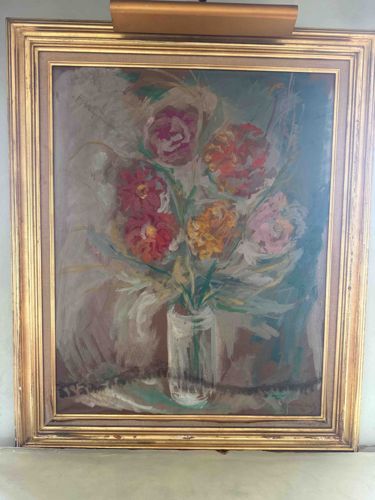
This item is an original oil or acrylic painting depicting a floral still life, characterized by an impressionistic style with visible brushstrokes and abstract qualities. The composition features a bouquet of flowers, likely zinnias or similar large-petaled blooms, in shades of red, orange, pink, and yellow, arranged within a clear glass vase. The vase shows simple striations, suggesting cut crystal or molded glass, and contains visible stems and hints of water. The background is rendered in broad, muted strokes of brown, grey, and teal, indicating a draped surface or indistinct setting behind the vase. The overall color palette is warm and inviting, with a focus on capturing light and atmosphere rather than precise botanical detail. The painting is housed in a substantial, ornate gilded wood frame, featuring a decorative raised edge and an inner fillet, which appears to be in good condition with minor signs of wear consistent with age, such as slight chipping or rubbing on the gesso and gilt surface, particularly noticeable on the bottom edge. There is a picture light attached to the top of the frame, suggesting a desire to illuminate the artwork, indicative of its display purpose. The painting itself appears to be under glass or a clear protective layer, and the visible surface does not show obvious cracks, tears, or significant paint loss. The quality of the brushwork suggests a skilled, though perhaps not formally academic, hand, with a focus on color blending and textural application. Given the style, it likely dates from the mid-20th century, possibly 1950s-1970s, aligning with a period when impressionistic and semi-abstract floral motifs were popular in home decor. No obvious artist's signature or maker's marks are discernible from the provided image.
AI Appraisal Report
Based on my remote visual examination of the provided image, this Impressionistic Floral Still Life painting, likely oil or acrylic, appears to be in very good condition for its assumed age. The colors are vibrant, and there are no discernible signs of major paint loss, cracking, or damage to the canvas surface. The ornate gilded wood frame, while showing minor wear on the gesso and gilt, particularly along the bottom edge, is consistent with age and typical handling. The presence of a picture light indicates its prior display as a valued decorative piece.
From the image alone, authenticating the medium (oil vs. acrylic) and exact age definitively is challenging. The 'under glass or protective layer' aspect also limits direct surface examination. Full authentication would require in-person inspection to assess the painting's surface texture, brushwork details not visible in photographs, and to confirm the medium. Removal from the frame might reveal signature or artist marks not currently visible. Provenance documentation, if available, such as purchase receipts or exhibition history, would also significantly aid in authentication and value assessment.
In terms of market conditions, impressionistic floral still lifes of this decorative quality from the mid-20th century (1950s-1970s) are generally appealing to a broad market, particularly for home decor. While not rare, the combination of good condition, attractive subject matter, and a substantial period frame enhances its desirability. The lack of a discernible artist's signature significantly limits its value as a collectible fine art piece, placing it more in the realm of decorative art. Comparables would include similar unsigned, decorative mid-century floral still lifes found in regional auctions or antique markets. The value is primarily driven by its aesthetic appeal, condition, and the quality of its framing rather than an established artist's market. Demand is generally consistent for such pieces, though intense competition is unlikely without a known artist.