These notes were written by the person who submitted this item. Appraiser.AI has not verified them, and the AI's identification and estimate may rely on them.
AI Estimated Value
Not an official valuation
$150-300
AI estimate as of August 6, 2025 · verify with a professional before acting
AI-Generated · Verify before acting
Everything on this page is generated by AI for informational purposes only. AI can make mistakes — the AI may misidentify items or misattribute them (artist, maker, brand, designer, origin, era). This is not an official valuation and should not be used for insurance, sale, tax, estate, legal, or lending purposes — or any decision requiring a certified appraisal. It is not an authoritative claim about any person, brand, or rights holder — do not share or rely on it as a factual statement about a third party. Always consult qualified professionals before making financial decisions.
This analysis also relies on unverified notes provided by the user, which may be incomplete or inaccurate and could affect the result.
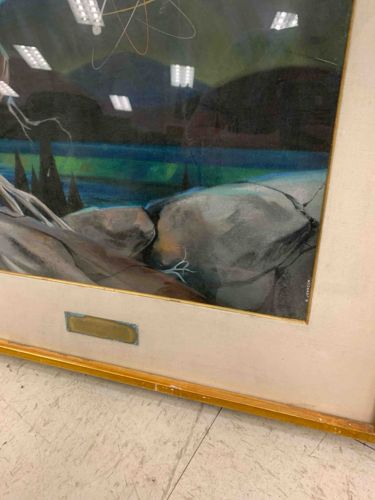
The item is a framed two-dimensional artwork, likely a painting or print, depicting a surreal or abstract landscape scene. The main colors visible are dark blues, greens, and grays, suggesting a nighttime or twilight setting with prominent landforms and a body of water. The reflection of overhead lights indicates the presence of a glass or acrylic cover over the artwork, which also obscures some of the finer details. In the upper left quadrant of the image, there appear to be yellow, possibly gold-toned, lines that form a complex, abstract, or perhaps scientific motif, resembling an atomic model or planetary orbits. Below this, the landscape features large, rounded rock formations in the foreground, rendered in shades of gray and brown. A body of water, possibly a lake or river, is visible in the mid-ground, characterized by a vibrant strip of turquoise or teal blue, which could represent aurora borealis or an unusual light source. The background consists of dark, undulating hills or mountains. The artwork is housed within a simple, light-colored mat board, likely off-white or cream, which frames the image. This mat board is then enclosed by a gilded or light-wood frame. The frame shows visible signs of wear, particularly along the bottom edge, where the finish is chipped and scuffed, revealing the lighter wood beneath. There is a rectangular brass or gold-colored plaque or label affixed to the bottom center of the mat board, which is currently unreadable due to blurriness and reflections. The signature 'E. JOHNSON' is faintly visible vertically along the right edge of the artwork itself, within the image. Based on the abstract and surreal elements, the style could be contemporary, dating from the late 20th or early 21st century. The craftsmanship appears to be of decent quality, with a well-composed scene, though the condition of the frame is fair due to wear.
AI Appraisal Report
Upon examining the images of the framed artwork signed 'E. Johnson,' titled 'The Algoma Story,' I have conducted an appraisal based on its visual characteristics. The piece presents a compelling abstract landscape, demonstrating competent use of color and composition. The style appears to be late 20th or early 21st century. The artwork itself seems to be in good condition under the protective glass, though the frame exhibits noticeable wear, including scuffs and chips, which detracts from its overall presentation and value. The signature 'E. Johnson' is noted, but this is a common surname, and without further provenance or a known listing for this artist, establishing a specific market is challenging. The value is therefore assessed based on its merits as a decorative piece of art by a lesser-known or regional artist. Comparable works from unlisted or regional artists of a similar size, style, and quality typically sell in the decorative art market. The primary factors limiting the value are the unknown identity and market history of 'E. Johnson,' the worn condition of the frame, and the lack of verifiable provenance. A definitive appraisal would require in-person examination to assess the medium (e.g., oil, acrylic, print), the quality of execution up close, and signs of age. Furthermore, full authentication would necessitate provenance research, such as exhibition history or records of sale, and a signature comparison to known works by any potential artist matches.