AI estimate as of August 30, 2025 · verify with a professional before acting
AI-Generated · Verify before acting
Everything on this page is generated by AI for informational purposes only. AI can make mistakes — the AI may misidentify items or misattribute them (artist, maker, brand, designer, origin, era). This is not an official valuation and should not be used for insurance, sale, tax, estate, legal, or lending purposes — or any decision requiring a certified appraisal. It is not an authoritative claim about any person, brand, or rights holder — do not share or rely on it as a factual statement about a third party. Always consult qualified professionals before making financial decisions.
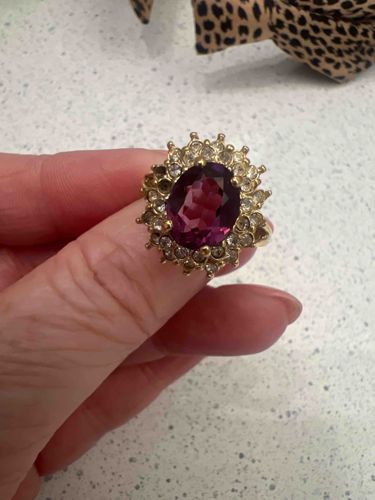
This item is a cocktail ring, likely electroplated gold or gold-filled, given its color and the overall aesthetic. The ring features a large, oval-cut central stone, which appears to be amethyst or a synthetic stone designed to mimic amethyst, judging by its deep purple hue with visible facets indicating a cut stone rather than a cabochon. This central stone is securely set, surrounded by a halo of smaller, round-cut colorless stones that sparkle, suggesting they are either diamonds, cubic zirconia, or another diamond simulant. These smaller stones are arranged in a sunburst or floral-like pattern, each individually prong-set, forming an ornate border around the main gem. The metal setting exhibits a rich yellow gold tone, and appears to be in good condition with no obvious signs of significant wear or tarnishing that would suggest poor care. The ring's band is visible and appears relatively slender, complementing the substantial size of the top cluster. The craftsmanship appears to be of a reasonable quality for costume or semi-fine jewelry, with stones evenly spaced and securely mounted. There are no visible maker's marks or signatures in the provided image. Based on its style, which features a prominent central stone surrounded by a halo of smaller stones, this ring could possibly date from the mid-20th century, perhaps from the 1950s to 1980s, when such elaborate cocktail rings were popular. The bright, uniform gold tone suggests it is not an antique piece, but rather a vintage item. There are no obvious signs of damage, such as missing stones, bent prongs, or significant scratches, indicating it has been well-maintained or is relatively new.
AI Appraisal Report
Upon visual examination of the provided image, I assess this cocktail ring. Its condition appears very good, with no obvious signs of missing stones, bent prongs, or significant wear to the metal finish. The bright, uniform yellow gold tone suggests it is not solid gold, but rather electroplated or gold-filled, a common characteristic for costume or semi-fine jewelry from the mid-20th century, likely 1950s-1980s. The central purple stone, likely amethyst or a synthetic simulant, is well-cut, and the surrounding halo stones (likely cubic zirconia or glass) are uniformly set, indicating decent craftsmanship for this category.
In terms of market conditions, vintage costume cocktail rings with large, colored central stones and clear halo settings are readily available. Comparables in similar condition typically retail in the $75-$150 range for electroplated or gold-filled pieces. Demand for such pieces is steady among collectors of vintage costume jewelry, but not exceptionally high, nor is the item particularly rare, given the common materials and design.
Factors significantly impacting value include the non-precious metals and likely synthetic or semi-precious stones. The absence of maker's marks is also typical for costume jewelry, but prevents attribution to a specific designer which could, in some cases, increase value. Without physical examination, I cannot definitively determine the exact composition of the metal (e.g., gold-filled vs. electroplated) or precisely identify the purple and colorless stones (e.g., natural amethyst vs. synthetic, diamond vs. CZ/glass). A precise identification of the stones would require gemological testing (refractometer, specific gravity, microscopy), and metal purity testing (XRF analysis, acid testing) would be necessary for full authentication and accurate valuation. Provenance documentation, if available, could also shed light on its history and origin.