AI estimate as of October 8, 2025 · verify with a professional before acting
AI-Generated · Verify before acting
Everything on this page is generated by AI for informational purposes only. AI can make mistakes — the AI may misidentify items or misattribute them (artist, maker, brand, designer, origin, era). This is not an official valuation and should not be used for insurance, sale, tax, estate, legal, or lending purposes — or any decision requiring a certified appraisal. It is not an authoritative claim about any person, brand, or rights holder — do not share or rely on it as a factual statement about a third party. Always consult qualified professionals before making financial decisions.
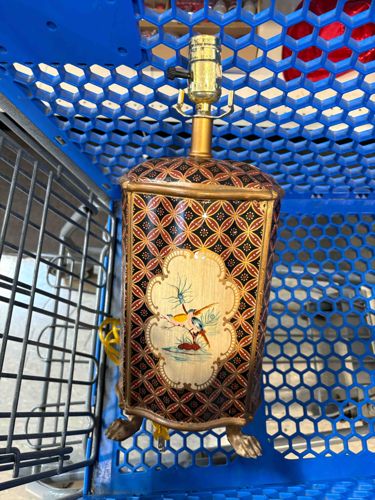
This is a vintage table lamp showcasing a distinctive Chinoiserie style, likely dating from the mid-20th century, possibly the 1950s to 1970s. The body of the lamp is rectangular with slightly bowed sides, giving it a subtle barrel or curved silhouette. It appears to be constructed from wood or a similar composite material, finished with a decorative lacquer or painted surface. The primary color scheme involves rich reds, blacks, and golds. The main body features an intricate, repeating geometric pattern, possibly resembling a batik or brocade textile design, with interconnected polygons and circles in black and gold on a reddish-brown background. Each of the four visible sides (assuming the design is consistent) features a central, cartouche-shaped panel. This panel is off-white or cream-colored and illustrates a Chinoiserie scene, in this case, a pair of detailed birds, possibly hummingbirds or kingfishers, perched or flying among reeds or thin branches above a body of water. The scene is rendered in muted blues, greens, yellows, and oranges. The edges of the lamp body are trimmed with a gilded or gold-painted finish, indicating a focus on ornate detailing. The lamp stands on four ornate feet, visible on the bottom, which appear to be made of metal (possibly brass or a brass-plated alloy) and are cast in an animalistic or claw-foot design, also with a gilded finish. The top of the lamp features a standard brass-tone lamp socket and harp holder, characteristic of lamps from its estimated period. Visible condition issues include potential wear to the gilded edges, minor scuffs or scratches on the lacquered surface consistent with age and use, and a slight patina on the metal components. The electrical components would need to be inspected for safety and functionality. The overall craftsmanship suggests a mass-produced decorative item, but with a good level of detail for its style.
AI Appraisal Report
This vintage Chinoiserie style table lamp, likely dating from the mid-20th century (1950s-1970s), presents a charming decorative aesthetic. Visually, the condition appears consistent with its age, showing expected wear such as minor scuffs, scratches on the lacquered surface, and some potential wear to the gilded edges. The metal components, including the ornate feet and socket, exhibit a gentle patina. Authenticity, based on visual examination alone, points towards a genuine vintage decorative piece, likely mass-produced rather than a singular artisanal creation. The design, with its intricate geometric patterns, Chinoiserie scenes featuring birds, and ornate gilded accents, is characteristic of the period. Market conditions for vintage decorative lighting of this type are generally stable, with prices largely depending on condition, specific design appeal, and manufacturer (if identifiable). Comparables in the secondary market suggest similar lamps often retail in the $100-$250 range, with higher values for items in exceptional condition or by known makers. Demand is moderate, appealing to collectors and decorators seeking specific vintage aesthetics. Rarity is low, as many such lamps were produced during this era. Factors significantly impacting value include the overall state of the lacquer and gilding, the integrity of the Chinoiserie panels, and crucially, the functionality and safety of the electrical components, which would require professional inspection. The primary limitation in this appraisal is the lack of physical examination. While the visual details are strong indicators, an in-person inspection would be needed to definitively assess the material composition (wood vs. composite), the extent of surface wear, any unseen damage, electrical safety, and to confirm the absence of any repairs. Provenance documentation or scientific material testing would be necessary for full, irrefutable authentication of materials and manufacturing origin.