AI estimate as of October 8, 2025 · verify with a professional before acting
AI-Generated · Verify before acting
Everything on this page is generated by AI for informational purposes only. AI can make mistakes — the AI may misidentify items or misattribute them (artist, maker, brand, designer, origin, era). This is not an official valuation and should not be used for insurance, sale, tax, estate, legal, or lending purposes — or any decision requiring a certified appraisal. It is not an authoritative claim about any person, brand, or rights holder — do not share or rely on it as a factual statement about a third party. Always consult qualified professionals before making financial decisions.
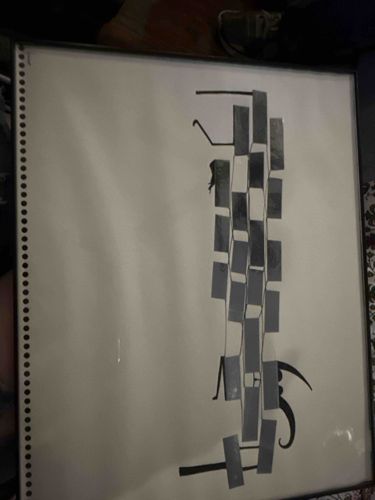
This item is a framed piece of abstract collage art, presented behind a clear protective layer, likely glass or acrylic, and enclosed within a dark, possibly black, thin frame. The artwork itself is constructed on a light-colored background, appearing to be white or off-white paper, which shows faint signs of creasing or unevenness, particularly on the left side where there are visible perforation holes, suggesting it might have been torn from a sketchbook or pad. The central motif of the collage consists of numerous rectangular and square-shaped pieces of material, predominantly in shades of gray, arranged vertically to form a column-like structure. These grey pieces exhibit variations in tone, some appearing darker and others lighter, creating a textured or dimensional effect. Interspersed within and alongside this column are dark, abstract linear elements, possibly ink or paint, forming jagged lines, curves, and solid rectangles that interact with the collage pieces. These dark elements appear to be drawn or painted directly onto the background paper. The overall composition is abstract and geometric, with a clear focus on verticality and the interplay of light and dark values. No discernible artist's signature, date, or other manufacturing marks are visible in the provided image. The condition appears stable, though minor inconsistencies in the paper background are noted. The style suggests a modern or contemporary aesthetic, likely from the mid-20th century onwards, given the abstract nature and collage technique. The craftsmanship in the arrangement of the collage elements appears deliberate, with an emphasis on visual balance and contrast, though the specific materials of the gray pieces (e.g., paper, metal foil) cannot be determined definitively from the image.
AI Appraisal Report
I have examined the provided image of this framed abstract collage art. The artwork appears to be in stable condition, housed behind a protective layer within a simple dark frame. The paper background shows some inconsistencies, including creasing and perforation holes on the left, suggesting it was torn from a pad. These minor imperfections are not uncommon for works on paper and do not significantly detract from its aesthetic appeal or overall stability. Authenticity cannot be definitively confirmed from an image alone. Without a visible signature or any discernible marks, the artist and origin remain unknown, which significantly impacts value. Physical inspection would be required to verify the medium and specific materials used in the collage elements.
Market conditions for unsigned, abstract collages by unknown artists are generally modest. While the piece exhibits a thoughtful composition with a strong use of verticality and contrast, its lack of provenance or an identifiable artist prevents it from commanding higher prices. Comparables would typically fall into the category of decorative modern art. Demand for such pieces is present but not robust, usually driven by aesthetic appeal for personal collection rather than investment. Rarity is difficult to assess without an artist's identity; however, similar unsigned abstract works are not exceptionally rare. For full authentication, an in-person examination to assess the paper, media, and any subtle identifying marks not visible in the image, along with any available provenance documentation, would be crucial. Scientific testing could potentially identify specific materials or pigments but would likely be cost-prohibitive for a piece of this type and value.