These notes were written by the person who submitted this item. Appraiser.AI has not verified them, and the AI's identification and estimate may rely on them.
AI Estimated Value
Not an official valuation
$800-1,500
AI estimate as of August 24, 2025 · verify with a professional before acting
AI-Generated · Verify before acting
Everything on this page is generated by AI for informational purposes only. AI can make mistakes — the AI may misidentify items or misattribute them (artist, maker, brand, designer, origin, era). This is not an official valuation and should not be used for insurance, sale, tax, estate, legal, or lending purposes — or any decision requiring a certified appraisal. It is not an authoritative claim about any person, brand, or rights holder — do not share or rely on it as a factual statement about a third party. Always consult qualified professionals before making financial decisions.
This analysis also relies on unverified notes provided by the user, which may be incomplete or inaccurate and could affect the result.
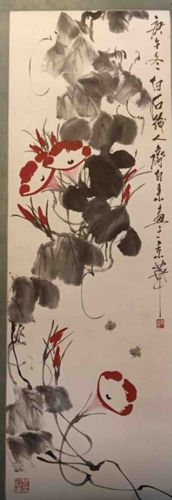
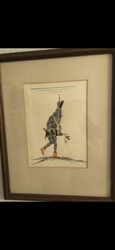
This is a vertical Chinese ink and wash painting, likely a scroll painting (Hanging Scroll or Handscroll). The artwork features a vibrant composition of flora and fauna, characteristic of traditional Chinese brush painting. The dominant colors are various shades of black and grey for the ink, with striking accents of red. The subject matter includes large, broad leaves rendered in different tones of grey and black ink, creating depth and volume. Interspersed among these leaves are several red elements: one prominently large red flower or fruit towards the top with white highlights, and a smaller, distinct red morning glory-like flower with a black center towards the bottom. Additionally, there are delicate red buds and stems. Small grey insects or butterflies are depicted near the middle and lower right, adding a touch of life and movement to the composition. The brushwork appears fluid and expressive, with varied ink washes demonstrating skillful control. There is Chinese calligraphy running vertically along the right side of the painting, executed in black ink, which likely includes a poem, inscription, or dedication. Below the calligraphy, two red square seals (chops) are visible, indicative of the artist's or collector's impression, serving as a signature or authentication mark. Another two red seals are located at the bottom left corner, also likely artist's seals. The painting is executed on a light-colored ground, likely paper or silk, which appears to be in good condition with no visible tears or significant discoloration, suggesting proper conservation, or a relatively recent creation within the last century. The overall aesthetic points to a master of the Hsieh-i (xieyi) or 'freehand' style, emphasizing spontaneity and conveying the spirit of the subject rather than strict realism. The composition is balanced yet dynamic, guiding the eye from top to bottom.
AI Appraisal Report
Upon examining this Chinese ink and wash painting, described as a vertical scroll, I am struck by its vibrant composition and clear execution, indicative of the Hsieh-i (xieyi) or 'freehand' style. The artwork appears to be in very good condition, with no visible tears, significant discoloration, or signs of extensive damage from the image provided. This suggests either excellent conservation or a relatively recent creation within the last century. The fluid and expressive brushwork, particularly in the varied ink washes for the leaves and the striking red accents of the flowers, demonstrates a high level of skill. The presence of Chinese calligraphy and multiple red seals (chops) is a strong indicator of authenticity within the tradition of Chinese brush painting, though their interpretation and true significance require expert translation and comparison with known artist seals.
Market conditions for quality traditional Chinese ink paintings remain robust, especially for works exhibiting strong artistic merit and good condition. Comparable works of similar size, quality, and style by recognized, though not necessarily master, artists typically fetch prices in the mid to high hundreds up to a few thousand dollars. The demand for such pieces is steady among collectors of Asian art. The rarity cannot be definitively assessed without identifying the artist.
Factors significantly impacting value include the artist's identity (if a known master, the value would be substantially higher), the specific content of the calligraphy, and the age of the piece.
It is crucial to note that this is a preliminary appraisal based solely on visual examination of an image and provided descriptions. Full authentication would necessitate an in-person examination to assess the paper or silk integrity, pigments, and precise dating techniques. Furthermore, expert translation of the calligraphy and verification of the artist's seals through established databases and art historical research are paramount for definitive attribution and value assessment. Provenance documentation, if available, would also greatly enhance its value and authenticity.