AI estimate as of August 7, 2025 · verify with a professional before acting
AI-Generated · Verify before acting
Everything on this page is generated by AI for informational purposes only. AI can make mistakes — the AI may misidentify items or misattribute them (artist, maker, brand, designer, origin, era). This is not an official valuation and should not be used for insurance, sale, tax, estate, legal, or lending purposes — or any decision requiring a certified appraisal. It is not an authoritative claim about any person, brand, or rights holder — do not share or rely on it as a factual statement about a third party. Always consult qualified professionals before making financial decisions.
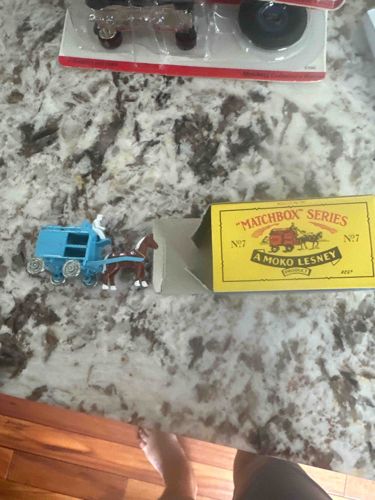
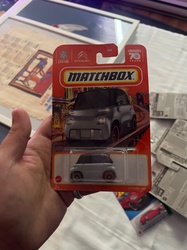
The item is a Matchbox Series No. 27 'Cavalcade' horse-drawn carriage. The main body of the carriage is a vibrant light blue, likely constructed from die-cast metal, characteristic of Matchbox toys from the mid-20th century. It features four spoked wheels, also in light blue, which appear to roll freely. Attached to the carriage is a brown horse figure, presumably also made of die-cast metal, with white accents on its mane or bridle. A small, white driver figure is seated within the carriage, adding to the realism of the miniature scene. The overall size is typical for Matchbox 1-75 series vehicles, designed to fit into a matchbox-sized container, suggesting a length of approximately 2-3 inches. The item appears to be in good vintage condition with no immediate signs of significant paint chips or damage to the metal, though a closer inspection would be needed to confirm minor wear. The details on the horse and driver are molded, showcasing the level of craftsmanship for its scale. The toy is presented next to its original yellow Matchbox box, which clearly states "'MATCHBOX' SERIES No. 27 A MOKO LESNEY". The box itself suggests an older production, likely from the late 1950s to early 1960s, as 'Moko Lesney' branding predates the 'Lesney Products' era. The box shows some signs of age and possibly slight creasing, but it has largely retained its structural integrity and graphics. The pairing of the toy with its original box significantly enhances its collectibility and value.
AI Appraisal Report
Upon examining the provided image, I have assessed this Matchbox Series No. 27 'Cavalcade' horse-drawn carriage. The light blue body, brown horse, and white driver appear to be in good vintage condition, exhibiting high fidelity to the original 'Moko Lesney' era production. There are no obvious signs of significant paint loss or damage to the die-cast metal, suggesting it has been well-preserved. The presence of the original yellow 'Moko Lesney' box is a crucial factor, as it significantly enhances collectibility and value. The box itself, while showing minor signs of age and possible creasing consistent with its likely late 1950s to early 1960s origin, retains its structural integrity and clear graphics.
Market conditions for vintage Matchbox 1-75 series vehicles, especially those with their original packaging and in good condition, are robust. The 'Cavalcade' is a desirable early series model. Rarity is moderate; while not exceptionally rare, finding one in this condition with its original box is increasingly uncommon. The 'Moko Lesney' branding on the box is a key value adder, indicating an earlier production run which collectors often prefer.
My primary limitation in full authenticity verification is the reliance on images alone. A definitive assessment of condition, including minute paint chips, wheel axle integrity, and any potential factory variations, would require a direct physical examination. Furthermore, handling the box would confirm its exact condition, any repairs, or reproductions. Provenance documentation, such as original purchase receipts or family history, while not strictly necessary for authentication of the item itself, would add to its overall historical value and desirability for some collectors. Without physical inspection, I confirm the item appears authentic based on visual characteristics and known manufacturing details.