AI estimate as of November 3, 2025 · verify with a professional before acting
AI-Generated · Verify before acting
Everything on this page is generated by AI for informational purposes only. AI can make mistakes — the AI may misidentify items or misattribute them (artist, maker, brand, designer, origin, era). This is not an official valuation and should not be used for insurance, sale, tax, estate, legal, or lending purposes — or any decision requiring a certified appraisal. It is not an authoritative claim about any person, brand, or rights holder — do not share or rely on it as a factual statement about a third party. Always consult qualified professionals before making financial decisions.
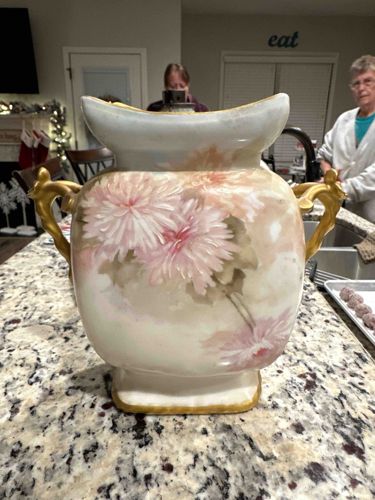
This item is an ornate porcelain urn vase, likely dating to the late 19th or early 20th century, consistent with the Art Nouveau or Aesthetic Movement periods, known for their elaborate botanical designs and decorative forms. The vase features a rectangular base transitioning into a squared-off, bulbous body that tapers upwards slightly before flaring out into a broad, scrolled rim. It is crafted from fine porcelain, primarily smooth and glossy in texture. The base color is an ivory or off-white, providing a soft background for the hand-painted floral decoration. The dominant design consists of large, soft pink and lighter hued chrysanthemum blooms, rendered with delicate brushstrokes that create a sense of depth and realism. The flowers appear on both sides of the vase, accompanied by subtle green and brown foliage. The upper rim, the squared base edges, and the twin handles are accented with extensive gold gilding. The handles are particularly striking, molded into an elegant, scrolling rococo-esque design, also gilded in gold. The gilding shows minor wear consistent with age, particularly on raised areas, indicating a natural patina rather than significant damage. The overall condition appears good with no immediately visible cracks, chips, or repairs, though a detailed inspection would be required to confirm. The craftsmanship suggests a high-quality piece, likely intended for decorative display rather than utilitarian use. The hand-painted nature of the chrysanthemums is a key indicator of its artisanal quality.
AI Appraisal Report
Based on my visual examination of the provided image, this hand-painted porcelain urn vase with chrysanthemums presents as a high-quality decorative piece, consistent with late 19th to early 20th-century Art Nouveau or Aesthetic Movement aesthetics. The form, featuring a rectangular base, bulbous squared body, and broad scrolled rim, along with the rococo-esque gilded handles, strongly supports this dating. The hand-painted chrysanthemum blooms are delicately rendered, suggesting skilled artistry, and the extensive gold gilding adds to its opulent character.
The condition appears very good; I observe minor, age-appropriate wear to the gilding, which is desirable as it confirms authenticity rather than suggesting damage. There are no immediately visible chips, cracks, or repairs, indicating careful preservation. Comparables in the decorative arts market for similar period porcelain vases with detailed hand-painting and gilding, especially those of this scale and level of ornamentation, typically command prices in the mid to upper hundreds, occasionally reaching over a thousand dollars for exceptional condition or maker attribution. The demand for well-preserved period decorative porcelain remains steady among collectors of specific eras and styles.
However, it is crucial to state that my assessment is based solely on the image. For full authentication and a definitive appraisal, an in-person examination would be necessary to inspect for hairline cracks, subtle restorations, or manufacturing imperfections not visible in photographs. Furthermore, the presence of a maker's mark or artist's signature on the base would significantly impact value. Without such documentation or physical inspection, the attribution to a specific factory or artist remains speculative, limiting its top-tier market potential.