These notes were written by the person who submitted this item. Appraiser.AI has not verified them, and the AI's identification and estimate may rely on them.
AI Estimated Value
Not an official valuation
$150-250
AI estimate as of July 14, 2025 · verify with a professional before acting
AI-Generated · Verify before acting
Everything on this page is generated by AI for informational purposes only. AI can make mistakes — the AI may misidentify items or misattribute them (artist, maker, brand, designer, origin, era). This is not an official valuation and should not be used for insurance, sale, tax, estate, legal, or lending purposes — or any decision requiring a certified appraisal. It is not an authoritative claim about any person, brand, or rights holder — do not share or rely on it as a factual statement about a third party. Always consult qualified professionals before making financial decisions.
This analysis also relies on unverified notes provided by the user, which may be incomplete or inaccurate and could affect the result.
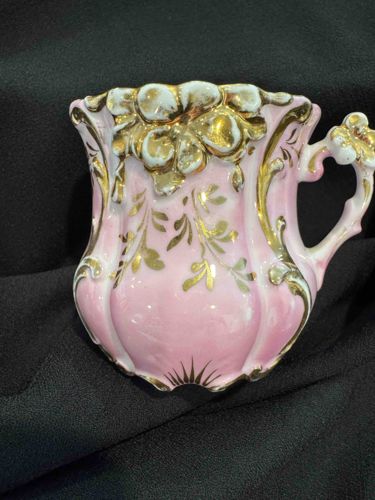
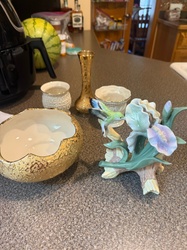
This exquisite item is a small, ornate decorative vase, likely intended as a bud or flower vase, crafted from porcelain or fine ceramic. Its dominant color is a soft, pastel pink, richly adorned with intricately applied gold and white enamel accents. The body of the vase features a fluted or ribbed design, creating a scalloped edge at the base and a wavy, organic rim at the top. The top rim is heavily embellished with raised, sculptural elements, possibly depicting stylized flowers or foliage, highlighted in bright gold and white. Similar, though less prominent, raised gold and white detailing can be observed on the handle, which terminates in a decorative flourish. The main body of the vase is further decorated with delicate, hand-painted or transfer-printed gilded scrolling foliage and tendril motifs. At the base, there are radiating gold lines, mimicking roots or sunbursts. The overall craftsmanship suggests a high level of detail and artistry, typical of Victorian or Edwardian era decorative porcelain. Visible condition issues are minimal; there appears to be some slight wear to the gold gilding, particularly on the raised elements, consistent with age and handling. There are no obvious cracks, chips, or repairs visible in the provided image. The glossy finish indicates a glazed surface. The piece exudes a delicate and luxurious aesthetic, characteristic of fine porcelain decorative items from the late 19th to early 20th century. Its small size, while not precisely measurable from the image, suggests it is suited for single blooms or small floral arrangements.
AI Appraisal Report
I have carefully examined the image of this Victorian/Edwardian Pink Porcelain Bud Vase with Gilt and Enamel Decoration. Based on visual assessment, the condition appears to be excellent, consistent with its age. I note some minor wear to the gilding, particularly on raised elements, which is typical for items of this vintage that have been handled and displayed. There are no visible chips, cracks, or repairs, which significantly contributes to its value. The craftsmanship, with its detailed fluting, scalloped base, organic rim, raised sculptural elements, and delicate hand-painted or transfer-printed gilded motifs, strongly suggests authenticity as a late 19th to early 20th-century decorative piece.
From a market perspective, there is consistent demand for well-preserved Victorian and Edwardian decorative arts, especially pieces with intricate detailing and appealing aesthetics like this vase. Comparable items of similar quality, condition, and attribution typically find buyers at auction or through specialized dealers. The appealing pastel pink color and extensive gilt and enamel work enhance its desirability. While not exceptionally rare, pieces in such good condition are less common.
Factors positively impacting value include the excellent overall condition, the detailed and complex ornamentation, and its visually appealing design. However, it is crucial to state that my assessment of authenticity and condition is based solely on a high-resolution image. For full authentication and a definitive condition report, an in-person examination would be essential to detect hairline cracks, hidden repairs, or the exact application technique (hand-painted vs. transfer). Provenance documentation would further solidify its history and authenticity. Scientific testing is typically not required for such an item unless there are specific concerns about material composition or age.