AI estimate as of July 17, 2025 · verify with a professional before acting
AI-Generated · Verify before acting
Everything on this page is generated by AI for informational purposes only. AI can make mistakes — the AI may misidentify items or misattribute them (artist, maker, brand, designer, origin, era). This is not an official valuation and should not be used for insurance, sale, tax, estate, legal, or lending purposes — or any decision requiring a certified appraisal. It is not an authoritative claim about any person, brand, or rights holder — do not share or rely on it as a factual statement about a third party. Always consult qualified professionals before making financial decisions.
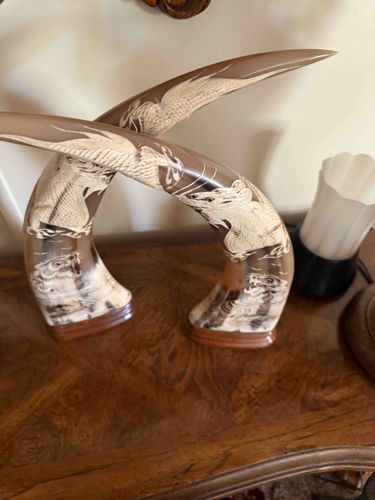
This appears to be a pair of large, elaborately carved and polished natural horn decorative pieces, likely from bovine horns due to their size and curvature. Each horn has a distinct, deep brown, semi-translucent coloration, showing natural variations and striations, particularly towards the wider base where it transitions to lighter, mottled tones. The surface of the horns is highly polished, reflecting light, and appears smooth. Each horn rests on a separate, flat, oval-shaped wooden base, stained a reddish-brown, providing stability. The most striking feature is the extensive, finely detailed low-relief carving that covers a significant portion of both horns. The carving depicts mythical creatures, specifically what appear to be dragons or similar serpentine beasts, rendered in a traditional East Asian artistic style. The carved areas are a lighter, almost off-white color, providing a strong contrast against the darker horn, suggesting the design was etched or scrimshawed into the horn's surface. The craftsmanship is evident in the intricate scales, flowing lines, and dynamic poses of the creatures. There are no immediately visible signs of significant damage such as cracks or chips, and the polish seems well-maintained, indicating good overall condition. No obvious maker's marks or signatures are discernible from the image. Based on the style of carving and material, these pieces likely date from the mid-to-late 20th century, possibly earlier, and showcase a high level of artisanal skill.
AI Appraisal Report
Upon my virtual examination of this pair of carved decorative natural horns with dragon motif, I assess their condition as very good. The horns exhibit a well-maintained polish and show no visible cracks, chips, or significant abrasions. The carved dragon motif is intricate and appears intact. Authenticity, based solely on visual inspection, suggests these are indeed natural horns, likely bovine, and the carving appears consistent with traditional East Asian decorative arts.
The market for natural horn decorative items, especially those with intricate folk or mythological carvings, remains consistently active. These pieces likely fall into the mid-to-late 20th century category, aligning with a period where highly detailed artisanal work was appreciated. Comparable items, particularly those found in online auctions or specialized decorative arts galleries, range widely depending on size, intricacy, and provenance. The elaborate dragon motif and seemingly high level of craftsmanship enhance their desirability. Demand for unique, expertly carved natural materials is moderately strong, catering to collectors of Asian art, decorative objects, and natural history specimens. While not explicitly rare, the quality of carving makes these pieces stand out amongst more common horn carvings.
Factors significantly impacting value include the intricate detail of the carving, the apparent excellent condition, and the substantial size of the horns. The dark, semi-translucent coloration of the horns provides a striking contrast to the lighter carved areas, further enhancing their aesthetic appeal.
It is crucial to note the limitations of authenticity verification from images alone. A definitive authentication would require an in-person examination to assess the material's precise composition, detect any synthetic elements, and inspect the carving for tool marks consistent with the presumed age. Furthermore, provenance documentation, such as records of acquisition or previous ownership, would significantly bolster their value and confirm their historical accuracy. Scientific testing, like carbon dating for the horn material or microscopic analysis of the pigments (if any), could conclusively confirm their age and authenticity.