AI estimate as of September 4, 2025 · verify with a professional before acting
AI-Generated · Verify before acting
Everything on this page is generated by AI for informational purposes only. AI can make mistakes — the AI may misidentify items or misattribute them (artist, maker, brand, designer, origin, era). This is not an official valuation and should not be used for insurance, sale, tax, estate, legal, or lending purposes — or any decision requiring a certified appraisal. It is not an authoritative claim about any person, brand, or rights holder — do not share or rely on it as a factual statement about a third party. Always consult qualified professionals before making financial decisions.
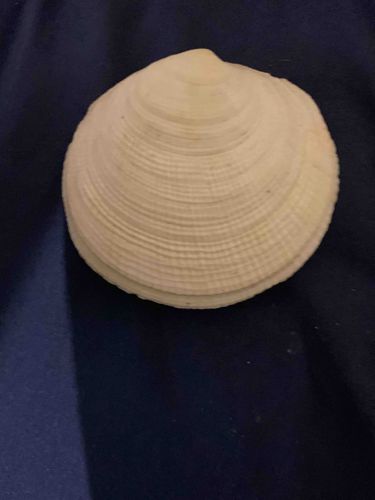
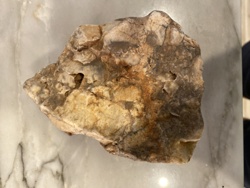
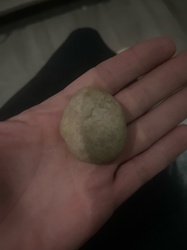
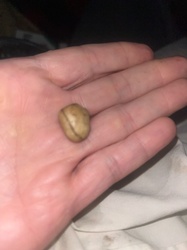
The item is a single bivalve shell, likely a clam or similar mollusk. It exhibits an off-white to very light cream coloration, suggesting it has been cleaned or naturally bleached over time, possibly by exposure to sun and elements. The shell is characterized by prominent concentric growth rings, or lamellae, which are clearly visible across its surface, indicating periods of growth. These rings are relatively evenly spaced, though they may become slightly more crowded towards the outer edge. The shell appears to be a complete valve, rather than a broken fragment. Its shape is broadly rounded to oval, with a slightly pointed or raised umbo (the oldest part of the shell) at the top. The surface texture is somewhat smooth between the ridges, but the ridges themselves provide a tactile, ridged feel. There are no obvious signs of recent damage such as cracks or chips, indicating fair to good preservation. There might be some subtle discoloration or very minor surface wear consistent with natural aging or beach-found specimens, but no significant aesthetic flaws are apparent. No manufacturing marks, signatures, or repairs are visible, as this is a natural object. Given its natural form and unadorned state, it does not belong to a specific human-made style period but is a product of natural biological growth. The quality is typical for a relatively intact and complete bivalve shell found in nature.
AI Appraisal Report
I have examined the provided image of this bivalve seashell. As a natural specimen, its authenticity is inherently confirmed by its biological form and the clear presence of growth rings characteristic of a bivalve mollusk. The condition appears to be fair to good, exhibiting an off-white to cream coloration, suggesting it has been naturally cleaned or aged. There are no visible chips, cracks, or significant damage, which is a positive for a natural object of this type. The integrity of the shell, particularly the distinct growth rings and intact umbo, indicates it's a well-preserved single valve.
From a market perspective, common bivalve shells like this are widely available. Their value is typically driven by factors such as rarity, size, unique coloration, or historical significance (e.g., from a specific, famous collection or historically important location). This particular shell does not exhibit any extraordinarily rare features, unusual size, or distinct color patterns that would elevate its market value significantly. Demand for common bivalve shells is generally low in the collector's market unless they are exceptionally pristine, very large, or belong to a rare species. Comparables would include other common beach-found or readily available shells, which typically retail for very modest sums.
Limitations in authenticity verification from an image alone are minimal for a natural object like this; its biological structure is evident. However, an in-person examination would allow me to physically assess the tactile quality of the surface, confirm the absence of subtle repairs or coatings that might not be visible in an image, and verify dimensions precisely. Provenance documentation is not typically applicable or needed for such a common natural specimen, nor is scientific testing beyond visual identification. The value reflects its status as a common, naturally occurring shell, suitable for decorative purposes or very basic natural history collections.