AI estimate as of October 22, 2025 · verify with a professional before acting
AI-Generated · Verify before acting
Everything on this page is generated by AI for informational purposes only. AI can make mistakes — the AI may misidentify items or misattribute them (artist, maker, brand, designer, origin, era). This is not an official valuation and should not be used for insurance, sale, tax, estate, legal, or lending purposes — or any decision requiring a certified appraisal. It is not an authoritative claim about any person, brand, or rights holder — do not share or rely on it as a factual statement about a third party. Always consult qualified professionals before making financial decisions.
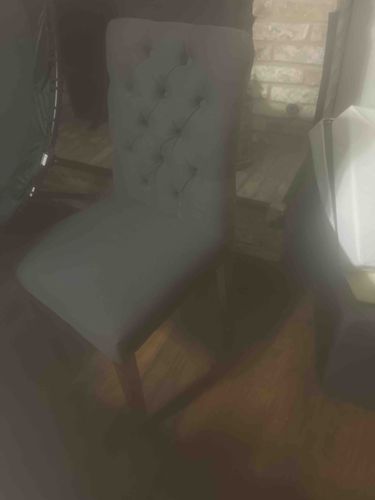
The item appears to be a contemporary or transitional style dining chair, featuring a tall, upholstered back and seat. The upholstery is a light, possibly grey or beige, fabric, which is deeply button-tufted across the entire backrest creating a classic Chesterfield or capitonné effect. This tufting employs fabric-covered buttons, pulling the material inward to create distinct pleats and diamond-shaped sections, indicating a certain level of craftsmanship often associated with elegant or formal furniture. The seat cushion is also upholstered and appears to be generously padded, suggesting comfort. The chair's frame, primarily visible in the legs, is constructed of wood, likely stained in a medium to dark brown tone. The legs are straight and appear sturdy, though specific joinery details are not discernible from the image. The overall condition of the upholstery seems fair, with no immediately obvious tears, stains, or significant wear visible, although the image quality makes a detailed assessment difficult. There are no visible manufacturer's marks or signatures. The chair's design suggests it could be part of a dining set, suitable for a formal dining room or an upscale kitchen area. Its clean lines combined with the traditional tufting lend it a versatile aesthetic, capable of blending with both classic and modern interior designs. The chair exhibits a quality of construction that suggests it is not a low-end piece, implied by the detailed tufting and solid-looking wooden legs.
AI Appraisal Report
Based on my visual examination of the provided image, this tufted dining chair appears to be a contemporary or transitional piece. The upholstery, a light-colored fabric with deep button-tufting on the backrest, suggests an elegant and somewhat formal aesthetic. The tufting indicates a good level of craftsmanship, a detail often found in mid-to-high quality furniture. The wooden legs, stained in a medium to dark tone, appear sturdy and well-proportioned for a dining chair. From the image, the overall condition of the upholstery seems fair, with no obvious major tears or stains, though a more detailed assessment would require a closer look.
In terms of market conditions, chairs of this style, blending classic tufting with clean lines, are generally desirable. They offer versatility and can fit into various interior design schemes, from traditional to modern farmhouse. Comparables in the new retail market for a single chair of this quality could range from $250-$500, depending on the manufacturer and specific materials. However, in the secondary market, which is where this appraisal sits, the value typically drops. There is a steady demand for well-constructed, aesthetically pleasing dining chairs, but these are not rare items.
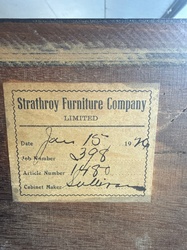
Factors impacting value include the apparent quality of construction, the classic tufted design, and its seemingly good condition. However, without knowing the manufacturer, precise age, or specific materials (e.g., solid wood vs. veneer, fabric composition), the value is limited. The most significant limitation in authenticity verification from an image alone is the inability to assess the internal frame, wood species, and the actual feel and durability of the upholstery. An in-person examination would be critical to check for structural integrity, hidden wear, fabric resilience, and manufacturer's labels. Provenance documentation would be useful for brand or age verification.