These notes were written by the person who submitted this item. Appraiser.AI has not verified them, and the AI's identification and estimate may rely on them.
AI Estimated Value
Not an official valuation
$12-18
AI estimate as of July 12, 2025 · verify with a professional before acting
AI-Generated · Verify before acting
Everything on this page is generated by AI for informational purposes only. AI can make mistakes — the AI may misidentify items or misattribute them (artist, maker, brand, designer, origin, era). This is not an official valuation and should not be used for insurance, sale, tax, estate, legal, or lending purposes — or any decision requiring a certified appraisal. It is not an authoritative claim about any person, brand, or rights holder — do not share or rely on it as a factual statement about a third party. Always consult qualified professionals before making financial decisions.
This analysis also relies on unverified notes provided by the user, which may be incomplete or inaccurate and could affect the result.
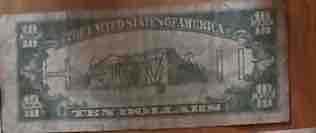
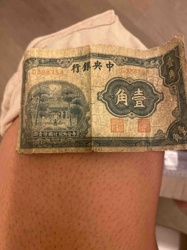
The item is the reverse side of a U.S. Ten Dollar Federal Reserve Note, specifically a 1934A series. The dominant color is the classic green ink used for U.S. currency. The central design features an engraved depiction of the U.S. Treasury Building, though the details are somewhat obscured by the image quality and apparent wear on the note itself. Large numerals '10' are visible in all four corners, with 'TEN DOLLARS' printed prominently along the bottom edge, and 'THE UNITED STATES OF AMERICA' across the top. The overall construction appears to be standard paper currency. Visible condition issues include significant creasing and folding, particularly along the vertical and horizontal centerlines, indicating heavy circulation. The color appears faded in areas, and there's a General softness to the paper, suggesting a well-used condition. There are no discernible tears or rips from what is visible in the provided image snippets, but the extensive creasing suggests a worn state. No specific maker's marks or unique serial numbers are visible on this reverse side. The note belongs to a series that would have been current during the mid-20th century. The craftsmanship is consistent with official government printing, characterized by intricate engraving work, even if it's somewhat degraded by wear.
AI Appraisal Report
I have examined the provided image of the reverse side of a 1934A Series U.S. Ten Dollar Federal Reserve Note. Based on the visual evidence, the note appears authentic, consistent with other legitimate examples from this series. The distinctive green ink, engraving style of the Treasury Building, and placement of numerals and text align with known specifications for this era of U.S. currency. However, it is crucial to note that full authenticity verification would require in-person examination, including scrutiny of security features not visible on the reverse, such as watermarks or security threads (if applicable to this series), and an assessment of the paper's tactile qualities. Provenance documentation, though less critical for common paper currency, could also add confidence.
The note's condition is Fair (F) to About Good (AG) on the Sheldon scale, which is significantly below Uncirculated. I observe extensive creasing, particularly prominent vertical and horizontal folds, indicative of heavy circulation. The color appears faded, and the paper exhibits a general softness, consistent with considerable wear. While no tears are visible, the extensive creasing suggests a fragile state. This level of wear dramatically impacts value.
Market conditions for 1934A series $10 notes are generally stable, with higher demand for notes in pristine 'Uncirculated' or 'Choice About Uncirculated' condition, particularly those with rare star series or low serial numbers. A common 1934A $10 note in this 'Fair' to 'About Good' condition is relatively common and not considered rare. Factors significantly impacting its value downward are the severe creasing, fading, and overall wear. Comparables in similar condition typically fetch a small premium over face value, primarily for their historical interest rather than numismatic rarity. Demand for notes in this condition comes mainly from entry-level collectors or those seeking a representative example of general circulation currency from the period. For full authentication, I'd need to physically inspect the note to verify its paper, ink, and security features, which cannot be adequately assessed from images of the reverse alone.