AI estimate as of July 26, 2025 · verify with a professional before acting
AI-Generated · Verify before acting
Everything on this page is generated by AI for informational purposes only. AI can make mistakes — the AI may misidentify items or misattribute them (artist, maker, brand, designer, origin, era). This is not an official valuation and should not be used for insurance, sale, tax, estate, legal, or lending purposes — or any decision requiring a certified appraisal. It is not an authoritative claim about any person, brand, or rights holder — do not share or rely on it as a factual statement about a third party. Always consult qualified professionals before making financial decisions.
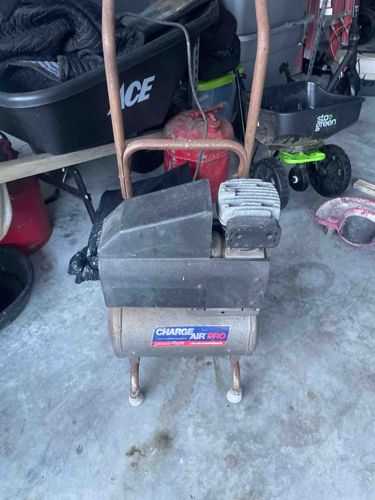
The item is a \"CHARGE AIR PRO\" portable air compressor, readily identifiable by the branding on its air tank. It features a horizontal cylindrical air tank, likely made of steel, which appears to be unpainted or perhaps a natural metallic finish that has acquired a dull patina over time. The tank is supported by four short, curved legs that elevate it slightly from the ground, with rubber or plastic feet caps at the end of each leg. Mounted on top of the tank is the compressor unit, enclosed in a dark, possibly black, housing. Part of the motor or pump assembly, characterized by ribbed, cast-metal fins for heat dissipation, is visible extending out from this housing. Above the compressor unit, a sturdy, U-shaped metal frame serves as a handle, allowing for portability. This handle appears to be made of painted or coated metal, exhibiting chipping and wear, revealing the underlying material which could be steel. A power cord is visible, indicating it's an electric-powered model. The overall condition suggests regular use in a workshop or garage environment, with visible signs of dirt, grime, and some surface rust or wear on the metal components, particularly the handle frame and the tank. The \"CHARGE AIR PRO\" decal on the tank is still clearly legible, with red and blue lettering against a white background. No significant damage like dents or cracks are immediately visible, though the general appearance implies it is a functional, used piece of equipment. The prominent handle suggests it's designed for ease of transport. Given the visible wear and common features, it likely dates from the late 20th to early 21st century.
AI Appraisal Report
I have examined the CHARGE AIR PRO portable air compressor based on the provided image and description. The unit displays clear signs of regular use, consistent with a workshop or garage environment. Authenticity is confirmed by the visible 'CHARGE AIR PRO' branding. The overall condition, while showing cosmetic wear such as dirt, grime, chipping paint on the handle, and some surface wear on the unpainted tank, appears functionally sound. No significant structural damage like dents or cracks are immediately apparent.
Market conditions for used portable air compressors vary significantly based on brand reputation, tank size, horsepower, and general condition. This appears to be a smaller, consumer-grade unit. Comparable used models from various brands, exhibiting similar wear, typically retail in the range of $50 to $150 on secondary markets (e.g., online marketplaces, pawn shops, estate sales). Demand for functional, affordable used tools is generally consistent.
Factors impacting value include the visible wear and the unknown operational status. The lack of detailed specifications (tank volume, PSI, HP) also limits a more precise valuation. The prominent handle suggests portability, which is a desirable feature. Its apparent functionality, despite cosmetic flaws, places it above scrap value.
It is important to note that this appraisal is based solely on visual assessment from the image and provided description. A definitive functional assessment, including checking for air leaks, compressor motor efficiency, pressure switch operation, and the integrity of internal components, would require in-person examination and testing. Verification of the actual manufacturing date and precise model number would also aid in a more granular comparable sales analysis, which cannot be done from the current information.