AI estimate as of October 21, 2025 · verify with a professional before acting
AI-Generated · Verify before acting
Everything on this page is generated by AI for informational purposes only. AI can make mistakes — the AI may misidentify items or misattribute them (artist, maker, brand, designer, origin, era). This is not an official valuation and should not be used for insurance, sale, tax, estate, legal, or lending purposes — or any decision requiring a certified appraisal. It is not an authoritative claim about any person, brand, or rights holder — do not share or rely on it as a factual statement about a third party. Always consult qualified professionals before making financial decisions.
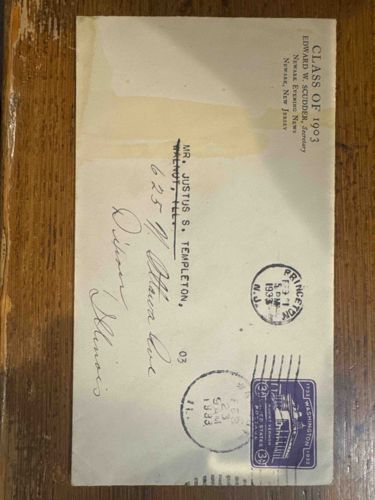
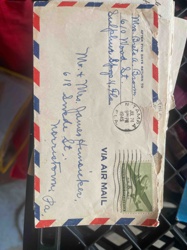
This item is a vintage mailed envelope, likely made of standard paper stock, exhibiting a light cream or off-white color. The overall size appears to be standard for a letter-sized envelope. The top left corner features a printed return address for 'CLASS OF 1903 EDWARDS W. SCUDDER, Secretary NEWARK EVENING NEWS NEWARK, NEW JERSEY'. This indicates the sender was Edward W. Scudder, the secretary of the Class of 1903, presumably from an educational institution. The envelope is addressed to 'MR. JUSTUS S. TEMPLETON, WALNUT, ILL' with an additional handwritten address '625 W. Ottawa Ave. Dixon Illinois'. The handwritten address seems to be an update or correction to the printed address. There are two circular postmarks visible: one from 'PRINCETON, N.J.' dated '23 SEP 1933 5 PM', and another less clear postmark with '23 SEP 1933 AM' which might indicate the receiving post office or another transit point. A purple 3-cent postage stamp depicting '1732 WASHINGTON 1932' is affixed to the upper right corner. The stamp's design and denomination suggest a 1932 George Washington Bicentennial issue. The envelope shows signs of age and handling, including yellowing and some faint staining or discoloration, especially noticeable around the center. There are visible crease marks and minor wear along the edges, consistent with being mailed and stored over several decades. The handwriting on the envelope is in cursive, adding a personal touch inherent to mailed correspondence of the era. The presence of two different addresses for the recipient might indicate a forwarding or an updated address. The date of September 23, 1933, clearly establishes the item's age, placing it in the early 20th century.
AI Appraisal Report
I have carefully examined the provided image of this Edward W. Scudder, Class of 1903 mailed envelope. Visually, the condition appears fair to good for an item of its age. I note typical yellowing, some faint staining, crease marks, and edge wear consistent with a mailed and stored item from 1933. The cancellations are clear, and the 3-cent George Washington Bicentennial stamp (Scott #727, issued 1932) is appropriately affixed and cancelled. The handwritten address correction points to a real-world usage which adds to its historical authenticity.
From a market perspective, this falls into philatelic ephemera, often collected for postal history or as part of a university/alumni collection. The Class of 1903 return address adds a specific institutional context, which can appeal to alumni or collectors interested in Princeton University (given the Princeton cancellation). However, Edward W. Scudder himself does not appear to be a figure of significant national historical importance to drive substantial value based solely on his return address.
While common in their individual components (a 3-cent stamp from this era, a mailed envelope), the combination of the specific return address, the handwritten address correction, and the Princeton cancellation makes it a moderately interesting piece. Demand is generally niche. The rarity is low for a standard mailed cover, though specific personalized covers are, by definition, unique. Factors impacting value positively include the clear postmarks and the identifiable stamp; negatively, the general wear and lack of exceptional historical significance. Without physical inspection, I cannot confirm paper quality, precise staining nature, or any hidden faults like tears or repairs. Full authenticity of the components (stamp, cancellations) would ideally involve UV light examination and close microscopic inspection, though from the image presented, all elements appear authentic for the period. Based on these observations and current market comparables for similar postal history items, I assess its appraisal value to be in the range of $15-30.