AI estimate as of August 3, 2025 · verify with a professional before acting
AI-Generated · Verify before acting
Everything on this page is generated by AI for informational purposes only. AI can make mistakes — the AI may misidentify items or misattribute them (artist, maker, brand, designer, origin, era). This is not an official valuation and should not be used for insurance, sale, tax, estate, legal, or lending purposes — or any decision requiring a certified appraisal. It is not an authoritative claim about any person, brand, or rights holder — do not share or rely on it as a factual statement about a third party. Always consult qualified professionals before making financial decisions.
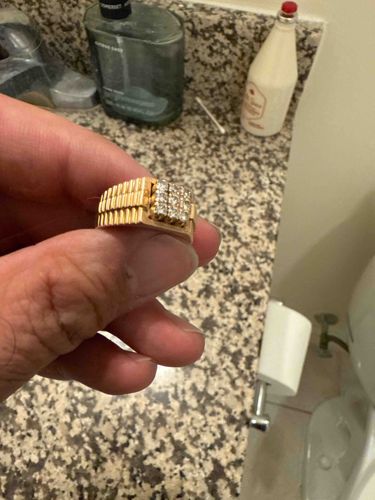
The item is a men's ring, likely cast in yellow gold, featuring a prominent rectangular face adorned with an array of pave-set diamonds. The surface of the ring's shank is characterized by a distinctive ribbed or grooved pattern, which extends symmetrically from the central diamond cluster on both sides. This textured design is reminiscent of machine-turned or fluted watch bracelet links, suggesting a robust and possibly masculine aesthetic. The diamonds appear to be round brilliant cuts, collectively forming a square or slightly rectangular cluster. While the exact carat weight or clarity cannot be determined from the image, they exhibit sparkle, indicative of natural diamonds or high-quality simulants. The setting style, known as pave, minimizes visible metal between the stones, maximizing their collective brilliance. The gold shows a polished finish with some visible wear, consistent with regular use, but no major dents or damage are apparent. There might be some minor surface scratches on the metal, which is typical for worn jewelry. The overall construction appears solid and well-crafted, with attention paid to the symmetrical placement of the ridges and the secure setting of the stones. Given the style, it likely dates from the late 20th century to early 21st century, possibly a vintage piece or a contemporary design inspired by classic jewelry aesthetics. No observable maker's marks or signatures are visible in the provided image.
AI Appraisal Report
Upon visual examination of the provided image of this men's gold and pave diamond ring, I assess its condition as good, consistent with regular wear. I observe minor surface scratches on the gold, which is typical for pre-owned jewelry, but no major dents, chips, or significant damage are apparent. The pave-set diamonds appear securely set, and their collective sparkle suggests natural diamonds, although this cannot be definitively confirmed without in-person testing. The yellow gold appears to be of standard fineness (likely 10k or 14k), given its appearance and the typical materials for this style of ring. The ribbed shank design is well-executed and symmetrical.
Authenticity of the diamonds as natural and the gold as genuine cannot be 100% verified from an image alone. Without physical inspection, I cannot perform scratch tests for gold purity, verify hallmark legitimacy, or use diamond testers to confirm authenticity and rule out simulants like moissanite or CZ. Spectroscopic analysis or gemological certification would be required for full diamond authentication. Furthermore, the exact carat weight, color, and clarity grades of the diamonds, which significantly impact value, cannot be determined visually. No maker's marks are visible, limiting provenance identification.
Considering current market conditions for pre-owned men's diamond jewelry, similar rings with approximately 0.50-1.00 carat total diamond weight (estimated from the image) and significant gold weight retail in the range of $800 to $2,500. Demand for men's diamond rings is steady, particularly for classic, robust designs. This piece is not rare; similar designs are relatively common. Factors significantly impacting value are the actual total carat weight, color, and clarity of the diamonds, and the gold karatage and weight. Without these precise details, the appraisal remains an estimation.
To provide a definitive appraisal, I would require a direct physical examination to assess diamond authenticity, gold purity and weight, and to identify any hidden hallmarks or damage. Gemological testing by a certified laboratory (e.g., GIA, AGS) for the diamonds would be crucial.