AI estimate as of August 27, 2025 · verify with a professional before acting
AI-Generated · Verify before acting
Everything on this page is generated by AI for informational purposes only. AI can make mistakes — the AI may misidentify items or misattribute them (artist, maker, brand, designer, origin, era). This is not an official valuation and should not be used for insurance, sale, tax, estate, legal, or lending purposes — or any decision requiring a certified appraisal. It is not an authoritative claim about any person, brand, or rights holder — do not share or rely on it as a factual statement about a third party. Always consult qualified professionals before making financial decisions.
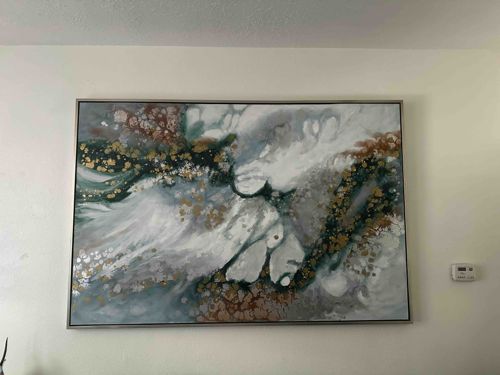
This is a large, rectangular abstract painting, likely created with fluid art techniques such as acrylic pouring or resin art. The dominant colors include various shades of grey, white, and teal/dark green, interspersed with vibrant metallic gold and hints of copper or rust brown. The composition features sweeping, swirling patterns resembling fluid motion, possibly depicting clouds, water, or organic forms. Scattered throughout the piece are clusters of what appear to be cells or small bubbles, characteristic of fluid art, particularly prominent in the areas with gold and silvery-white accents. The texture appears to be relatively smooth with some raised areas due to the layering of paint or medium, especially where the cells have formed. The painting is framed in a simple, slim, silver or light-colored metal frame, which complements the cool tones of the artwork without distracting from the central image. There are no immediately visible condition issues such as tears, significant scratches, or major paint loss, and the colors appear vibrant. Without closer inspection, no discernible artist's signature, maker's marks, or specific manufacturing details are visible on the front. Based on the style, it appears to be a contemporary piece, likely from the last 20-30 years, designed for modern interior decor. The craftsmanship appears to be of good quality, given the clean lines of the frame and the seemingly well-executed fluid art technique.
AI Appraisal Report
I have examined the provided image of this abstract fluid art painting with gold and teal accents. Visually, the condition appears excellent; there are no obvious flaws like tears, major scratches, or paint loss. The colors remain vibrant. Authenticity, based solely on visual inspection of an image, is limited. This style of art, common in contemporary decor, often lacks detailed maker's marks visible from a distance. A physical examination would be crucial to confirm the materials (acrylic, resin, specific pigments), assess surface texture, identify any hidden artist's signatures or studio marks on the reverse, and detect potential repairs or hidden damage. Provenance documentation, such as purchase receipts or certificates of authenticity, would further solidify its origin and artist. Scientific testing (e.g., pigment analysis) is typically not warranted for contemporary decorative art of this type unless a specific artist of high repute is claimed.
From a market perspective, fluid art, particularly pieces emphasizing metallic accents and popular color palettes like teal and gold, is currently in moderate to high demand for modern interior design. It's aesthetically pleasing and versatile. However, rarity is low; many artists and studios produce similar works, making it a competitive market. Comparables can be found across various online art marketplaces and galleries specializing in contemporary decor. Factors positively impacting value are its good condition, appealing abstract aesthetic, and the quality of the frame. The primary limitation on value is the lack of a known, established artist, which is common for decorative fluid art. Without an artist's name or documented exhibition history, its value is primarily decorative.