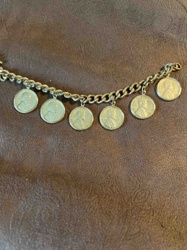
These notes were written by the person who submitted this item. Appraiser.AI has not verified them, and the AI's identification and estimate may rely on them.
AI Estimated Value
Not an official valuation
$175-250
AI estimate as of August 2, 2025 · verify with a professional before acting
AI-Generated · Verify before acting
Everything on this page is generated by AI for informational purposes only. AI can make mistakes — the AI may misidentify items or misattribute them (artist, maker, brand, designer, origin, era). This is not an official valuation and should not be used for insurance, sale, tax, estate, legal, or lending purposes — or any decision requiring a certified appraisal. It is not an authoritative claim about any person, brand, or rights holder — do not share or rely on it as a factual statement about a third party. Always consult qualified professionals before making financial decisions.
This analysis also relies on unverified notes provided by the user, which may be incomplete or inaccurate and could affect the result.
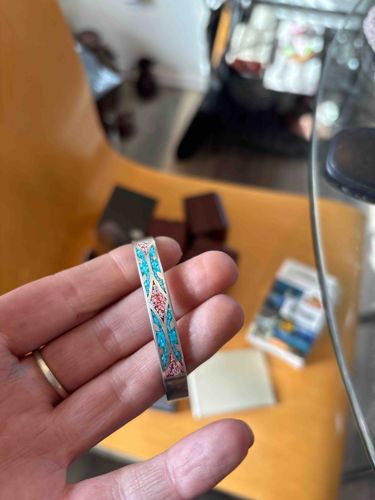
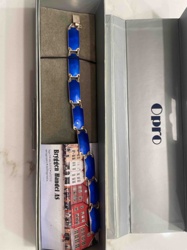
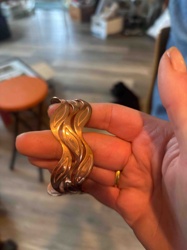
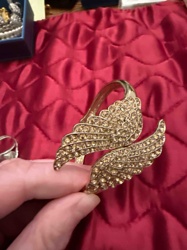
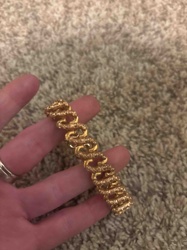
This item is a narrow, rigid cuff bracelet crafted from a silver-toned metal, likely sterling silver given its appearance and the typical materials for this style of jewelry. The bracelet features an intricate inlay design across its visible top surface, approximately three-quarters of its circumference, with the bottom quarter appearing to be plain metal for comfort and structural integrity. The inlay showcases a repeating geometric or stylized floral pattern, primarily utilizing mosaic-set micro-chips of two distinct materials: vibrant turquoise blue and a softer, mottled reddish-pink material, possibly coral, spiny oyster, or a similarly colored stone. The blue and pink sections are arranged in alternating diagonal or chevron-like segments, creating a visually appealing contrast. Each color segment appears to be bordered by thin strips of the silver-toned metal, giving the impression of meticulous craftsmanship and setting. The surface of the inlay is relatively smooth, indicating a well-finished piece where the stones are flush with the surrounding metal. Visible condition issues include a subtle, aged patina on the silver-toned metal, which is consistent with age and natural oxidation, enhancing the antique aesthetic. There are no immediately obvious chips or losses to the inlaid stones from the provided images, suggesting good preservation of the inlay work. Individual stones within the mosaic appear tightly set, indicating quality construction. While no specific maker's marks or signatures are visible from the image, the style strongly suggests a Native American Zuni or Navajo origin, known for their precise inlay work, particularly with turquoise and coral. The aesthetic places it likely within the mid-20th century to late 20th century, a period when such mosaic inlay work was highly prevalent and celebrated. The craftsmanship appears to be of good quality, with attention to detail in the precise cutting and setting of the numerous small stones.
AI Appraisal Report
Upon examining the images provided, I have assessed this cuff bracelet, which features an intricate mosaic inlay design. The piece is constructed from a silver-toned metal, presenting characteristics consistent with sterling silver, which is common for this style of jewelry. The inlay work is composed of turquoise and a reddish-pink stone, likely coral or spiny oyster, arranged in a precise geometric pattern. The craftsmanship appears to be of high quality, with no visible loss of stones and a well-preserved, smooth surface, suggesting it is a well-made example of its type. The style strongly suggests mid-20th-century Native American origin, specifically Zuni or Navajo, known for this 'chip inlay' technique.
The market for vintage Native American jewelry remains strong, with collectors valuing authentic, well-crafted pieces. Similar sterling and turquoise chip inlay bracelets from this era typically sell in the $150 to $300 range, depending on the artist, complexity, and condition.
The primary factor influencing value is its authenticity and the specific artist, which cannot be confirmed from images alone. The presence of a hallmark or signature, if it exists, would be critical. While authentic in style, a definitive attribution requires in-person examination to test the metal for sterling content, identify the specific stones, and properly research any maker's marks. Without physical inspection and provenance documentation, this appraisal is based on the visual characteristics and current market data for comparable, unsigned pieces.