AI estimate as of July 8, 2025 · verify with a professional before acting
AI-Generated · Verify before acting
Everything on this page is generated by AI for informational purposes only. AI can make mistakes — the AI may misidentify items or misattribute them (artist, maker, brand, designer, origin, era). This is not an official valuation and should not be used for insurance, sale, tax, estate, legal, or lending purposes — or any decision requiring a certified appraisal. It is not an authoritative claim about any person, brand, or rights holder — do not share or rely on it as a factual statement about a third party. Always consult qualified professionals before making financial decisions.
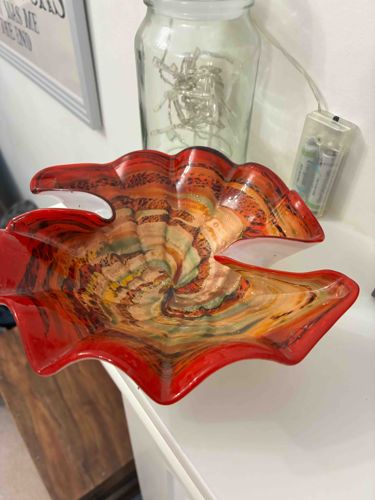
This appears to be a contemporary art glass bowl or centerpiece, characterized by its vibrant, multi-colored design and organic, freeform shape. The physical characteristics indicate a substantial piece, likely hand-blown or formed, given the undulating rim and non-symmetrical structure. The primary colors visible are a deep, opaque red on the exterior and rim, which transitions into a swirling pattern of earthy tones within the bowl's interior. These interior colors include shades of red, orange, yellow, green, and brown, creating a marbled or striated effect that suggests the inclusion of multiple glass canes or frit during its creation, which were then stretched and swirled. The surface appears smooth and glossy, indicative of polished glass. The form suggests it could be inspired by natural elements, perhaps a large leaf or a stylized wave. There are no immediately visible condition issues such as chips, cracks, or significant abrasions from the provided image; the surface appears clean and intact, displaying good craftsmanship and material quality. No specific maker's marks or signatures are discernable from the image. Its style suggests a modern or contemporary period, likely post-1980s, emphasizing artistic expression over strict utility. The unique color blending and form make it a distinctive decorative object, reflecting the skill involved in its glassworking technique.
AI Appraisal Report
Upon visual examination of the provided image, this multi-colored freeform art glass bowl presents as a striking contemporary decorative object. The 'condition' appears excellent, with no visible chips, cracks, or significant abrasions on the glossy surface. The vibrant, swirling colors and organic, undulating form suggest it is a substantial, likely hand-blown or formed piece. The technique, involving multiple glass canes or frit, demonstrates a good level of craftsmanship.
From the image alone, 'authenticity' is limited. While it clearly is art glass, determining its maker or origin (e.g., specific studio, artist) is impossible without a discernible signature or maker's mark. The style suggests a post-1980s contemporary period.
In terms of 'market conditions and comparables', comparable multi-colored freeform art glass bowls from unidentifiable contemporary artists typically retail in the lower to mid-hundreds. Pieces from known, established artists would command significantly higher prices. 'Demand' for decorative art glass remains consistent, though freeform, colorful pieces usually appeal to a broader market than highly abstract or monochrome works. 'Rarity' cannot be assessed without knowing the artist or production volume; it is likely a unique piece rather than mass-produced, but not necessarily rare in the broader art glass market.
Factors significantly impacting value include the lack of a known artist, which prevents it from entering a higher tier of the collectible art market. Its primary value derives from its aesthetic appeal, decorative function, and evident quality of craft. For 'full authentication' (e.g., confirming artist, period), a physical examination would be crucial to locate any hidden marks, assess the pontil mark, and scrutinize the glass composition. Provenance documentation (receipts, acquisition history) would also be invaluable. Scientific testing is generally not applied to contemporary decorative glass unless authenticity to a specific, high-value artist is in question.