These notes were written by the person who submitted this item. Appraiser.AI has not verified them, and the AI's identification and estimate may rely on them.
AI Estimated Value
Not an official valuation
$25-45
AI estimate as of September 5, 2025 · verify with a professional before acting
AI-Generated · Verify before acting
Everything on this page is generated by AI for informational purposes only. AI can make mistakes — the AI may misidentify items or misattribute them (artist, maker, brand, designer, origin, era). This is not an official valuation and should not be used for insurance, sale, tax, estate, legal, or lending purposes — or any decision requiring a certified appraisal. It is not an authoritative claim about any person, brand, or rights holder — do not share or rely on it as a factual statement about a third party. Always consult qualified professionals before making financial decisions.
This analysis also relies on unverified notes provided by the user, which may be incomplete or inaccurate and could affect the result.
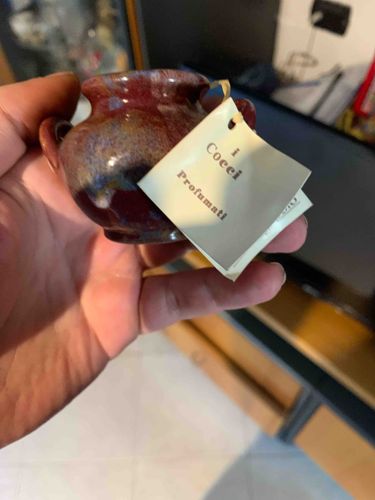
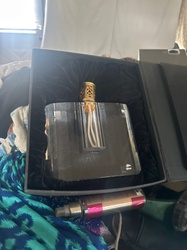
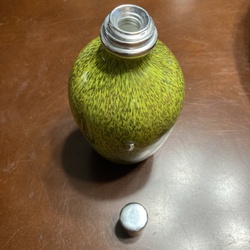
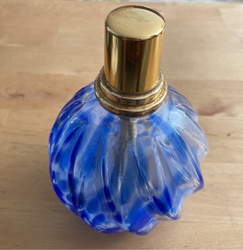
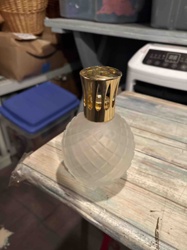
This is a small, amphora-style ceramic vase, designed to be held comfortably in the palm of a hand, suggesting a height of approximately 2-3 inches. It is crafted from pottery, likely earthenware, given the slightly rustic appearance of the glaze. The primary color is a rich, deep burgundy or claret red, adorned with sporadic, iridescent blue and purple crystalline glazes that create a mottled, almost metallic sheen in certain areas. This reactive glaze application provides a unique, organic pattern, making each piece distinct. The vase features a classic amphora silhouette with a narrow neck, a slightly wider body, and two small, loop-shaped handles positioned gracefully on either side, emanating from just below the lip and attaching to the upper body. The rim of the vase appears slightly flared. The overall construction exhibits good craftsmanship, indicative of a studio pottery piece or a small-scale artisanal production. There are no immediate visible signs of damage, chips, or cracks; the surface appears smooth and intact, reflecting light consistently. The presence of a paper tag, bearing the text "i Coeei" and "I Profumati," strongly suggests that this item is intended as a scented diffuser, perhaps for 'profumati' or scented oils/liquids, rather than a purely decorative vase for flowers. This functional aspect is a key distinguishing feature. The style appears contemporary, possibly from the late 20th or early 21st century, given the modern glazes and the tag's typography. The quality of the glaze application indicates careful attention to detail, creating a visually appealing and tactile object.
AI Appraisal Report
Upon my virtual examination of the Miniature Ceramic Amphora-Style Vase, I find it to be in excellent condition, showing no visible chips, cracks, or surface abrasions. The integrity of the glaze appears consistent and well-preserved. Authenticity, based solely on the provided image, points to a contemporary studio pottery piece or small-scale artisanal production, rather than a mass-produced item. The "i Coeei" and "I Profumati" tags strongly suggest its original intent as a home fragrance diffuser, likely for scented oils. This functional aspect, alongside its decorative appeal, enhances its marketability.
Market conditions for small, contemporary ceramic diffusers or decorative vases of this nature are generally moderate. Comparable items in this size and quality, particularly those with unique reactive glazes, typically retail in the $25-$45 range. While the craftsmanship is good and the glaze visually appealing, the item is not exceptionally rare, nor does it carry the provenance of a highly sought-after artist or historical significance that would drive a higher valuation. The "Thun hall mare" mention, while noted, does not significantly alter the valuation as this appears to be a descriptive tag rather than an artist's signature or a known, highly collectible brand.
Limitations in authenticity verification are inherent when appraising from images alone. A physical examination would allow me to assess the weight, tactile quality, and internal construction more thoroughly. I could also inspect for any subtle manufacturing marks, artist signatures (if present and hard to discern from the image), or internal residue that might further confirm its diffuser function. Provenance documentation, such as original purchase receipts or artist statements, would provide definitive confirmation of its origin and specific maker, which could, in some cases, slightly impact value if a known artist were identified. Scientific testing, while unnecessary for this type of item, might involve glaze analysis to determine exact composition, but this would not be cost-effective or relevant for this appraisal.