These notes were written by the person who submitted this item. Appraiser.AI has not verified them, and the AI's identification and estimate may rely on them.
AI Estimated Value
Not an official valuation
$65-125
AI estimate as of September 27, 2025 · verify with a professional before acting
AI-Generated · Verify before acting
Everything on this page is generated by AI for informational purposes only. AI can make mistakes — the AI may misidentify items or misattribute them (artist, maker, brand, designer, origin, era). This is not an official valuation and should not be used for insurance, sale, tax, estate, legal, or lending purposes — or any decision requiring a certified appraisal. It is not an authoritative claim about any person, brand, or rights holder — do not share or rely on it as a factual statement about a third party. Always consult qualified professionals before making financial decisions.
This analysis also relies on unverified notes provided by the user, which may be incomplete or inaccurate and could affect the result.
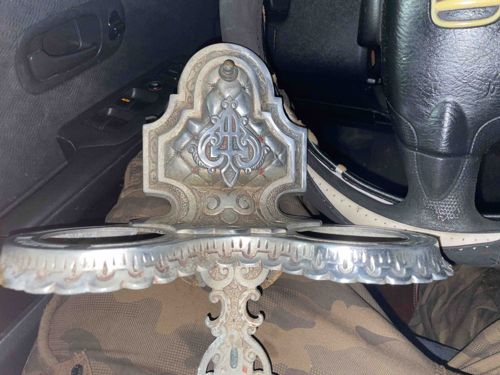
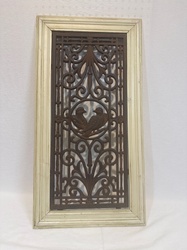
This item is an ornate cast metal component, likely a wall sconce or a decorative mount for a light fixture, characterized by its intricate design and robust construction. The primary material appears to be a heavy, silvery-gray metal, possibly cast iron or aluminum, with visible signs of age and tarnishing, suggesting a vintage origin. The overall color is a dull metallic silver with hints of reddish-brown oxidation, particularly in the recessed areas and along the edges, indicating a natural patina developed over time. The piece features a central decorative backplate with a highly stylized, almost cartouche-like, design. Within this central motif is a prominent, ornate letter 'A' or what appears to be a monogram 'JA' or 'AJ', surrounded by rococo-inspired scrollwork and shell patterns. Above this, there's a smaller, crown-like or finial-esque element. The edges of the backplate are scalloped and textured with a repeating pattern. Extending from the bottom of the backplate, two circular holders with scalloped rims are visible, suggesting they were intended to hold light bulbs (possibly with glass shades or candles in an earlier adaptation) or other decorative elements. The craftsmanship is detailed, showing evidence of molding or casting techniques with fine lines and textures. The surface has a somewhat rough, weathered texture typical of aged cast metal, with some areas showing minor pitting and discoloration. There are no obvious signs of recent damage or repairs, but the general condition indicates wear consistent with its age and exposure. The design aesthetic points towards a late 19th to early 20th-century period, possibly Art Nouveau or Neoclassical revival, given the ornate flourishes and initial detailing. The quality of the casting appears good, with clear definition of the decorative elements.
AI Appraisal Report
Upon examination of the provided image, this item presents as a single ornate cast metal wall sconce backplate from the late 19th or early 20th century. The design, incorporating a prominent 'A' or 'AJ' monogram within a rococo-style scrollwork cartouche, is characteristic of Neoclassical or Art Nouveau revival styles. The material appears to be cast iron or possibly a heavier cast aluminum, exhibiting a natural patina with some surface oxidation and minor pitting consistent with its age. The casting quality is good, retaining clear decorative details.
The market for architectural salvage, particularly individual lighting components like this, is quite specific. As a single piece rather than a matched pair, its value is significantly impacted. Pairs of similar sconces can fetch several hundred dollars, but a single unit is often sought for restoration projects or as a decorative accent. My valuation of $65-$125 is based on recent sales of comparable single, non-electrified, cast metal sconce backplates from this era on online marketplaces and auction sites. Its decorative appeal and the monogram detail are positive factors, but its status as an incomplete, single fixture is the primary limiting factor.
It is important to note that this appraisal is based solely on visual information from an image. Full authentication would require in-person examination to confirm the metal composition through weight and surface testing, identify any manufacturer's marks, and assess the structural integrity of the metal. Without physical inspection or provenance, verifying the exact age, origin, and manufacturer is not possible.