AI estimate as of October 4, 2025 · verify with a professional before acting
AI-Generated · Verify before acting
Everything on this page is generated by AI for informational purposes only. AI can make mistakes — the AI may misidentify items or misattribute them (artist, maker, brand, designer, origin, era). This is not an official valuation and should not be used for insurance, sale, tax, estate, legal, or lending purposes — or any decision requiring a certified appraisal. It is not an authoritative claim about any person, brand, or rights holder — do not share or rely on it as a factual statement about a third party. Always consult qualified professionals before making financial decisions.
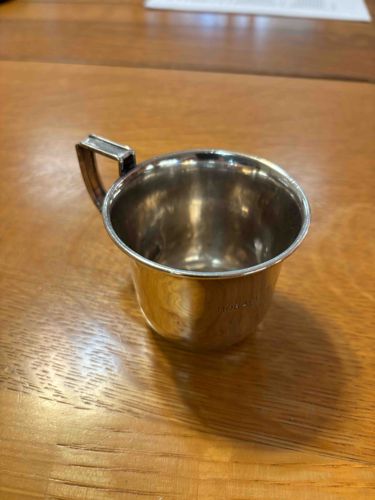
This item is a small, cylindrical drinking cup with a single handle, fashioned from a lustrous silver-colored metal, likely sterling silver or silverplate due to its typical appearance and application as a child's item. The cup features a smooth, polished finish, reflecting light brightly, indicating good surface condition with minimal pitting or deep scratches. The rim is simple and unadorned, presenting a clean line. The handle is an integral part of the design, appearing to be a flat, squared-off strap that is soldered or otherwise securely attached to the upper and lower sections of the cup's body. Its angular design suggests a more modern or Art Deco influence rather than a rococo or ornate style, placing its estimated age possibly in the early to mid-20th century. Inside the cup, a small etching or engraving is visible, which could be a maker's mark, an inscription, or an initial, though its exact details are not discernible from the provided image. The overall construction appears solid and well-crafted, indicative of quality manufacturing intended for regular use. There are minor signs of surface wear consistent with age and handling, such as faint scratches and a subtle tarnishing or patina in some areas, particularly within the handle's crevices and along the inner surface, which is typical for silver objects. No significant dents, dings, or repairs are immediately apparent, suggesting careful preservation. The craftsmanship, evident in the seamless integration of the handle to the body and the polished surface, points to a piece made with attention to detail.
AI Appraisal Report
Upon visual examination of this silver child's drinking cup, I find it to be in very good condition with minor surface wear consistent with its likely age and utility. The lustrous silver-colored metal, while not definitively identified as sterling silver from the image alone, presents as a quality material often used for such items. The seamless integration of the flat, squared-off handle and the polished finish suggest solid craftsmanship. Its angular design points to an early to mid-20th-century origin, possibly aligning with Art Deco aesthetics. The subtle tarnishing and faint scratches are typical for a used silver object, but I observe no significant dents, dings, or repairs.
Market conditions for vintage children's silver items are generally stable, driven by collectors and those seeking thoughtful gifts. Comparable sterling silver child's cups from this era often retail in the $150-$300 range, while silverplate examples typically fall below $100. Demand exists for well-preserved pieces, though rarity is not a primary factor unless attributed to a renowned maker or featuring unique engravings. The small etching inside warrants further investigation as it could be a maker's mark, significantly impacting value if from a well-known silversmith.
Limitations in authenticity verification are inherent when examining images alone. I cannot definitively confirm the metal composition (sterling vs. silverplate), nor can I fully decipher the internal etching's details or content. A physical inspection would allow for precise testing of the metal, a detailed examination of the engraving under magnification, and a thorough search for hallmarks. Provenance documentation, if available, would also add significant value by confirming origin and history.