AI estimate as of July 30, 2025 · verify with a professional before acting
AI-Generated · Verify before acting
Everything on this page is generated by AI for informational purposes only. AI can make mistakes — the AI may misidentify items or misattribute them (artist, maker, brand, designer, origin, era). This is not an official valuation and should not be used for insurance, sale, tax, estate, legal, or lending purposes — or any decision requiring a certified appraisal. It is not an authoritative claim about any person, brand, or rights holder — do not share or rely on it as a factual statement about a third party. Always consult qualified professionals before making financial decisions.
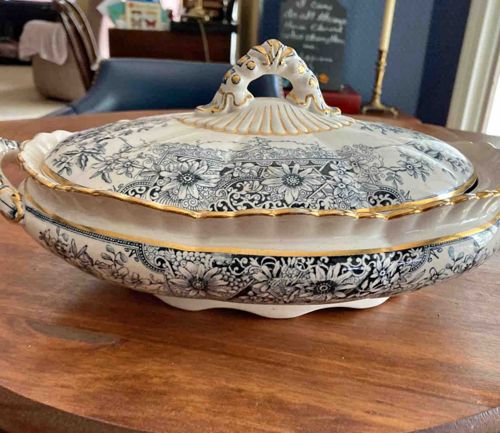
This is a vintage or antique ceramic covered serving dish, likely a tureen or a covered vegetable dish, exhibiting a distinctive aesthetic. The dish is primarily off-white or cream-colored, adorned with an intricate black and white transferware pattern. The pattern features a dense arrangement of floral motifs, possibly including sunflowers and various other blossoms, intertwined with leafy scrolls and geometric elements. The overall design suggests a Victorian or Edwardian era aesthetic, commonly associated with the mid-to-late 19th or early 20th century. A significant feature is the extensive use of gold gilt detailing, which highlights the scalloped edges of both the lid and the base, as well as the ornate handle on the lid and the handles on the vessel itself (though only one is clearly visible). The lid's handle is particularly decorative, with a shell-like or volute form, further embellished with gold. The body of the dish is oval or elongated in shape, with a slightly fluted or ribbed texture visible on the lid and possibly the base, adding to its visual complexity. There are no immediately obvious chips, cracks, or significant damage, suggesting it has been well-preserved or carefully handled. However, the gold gilt shows some signs of wear, particularly on the raised areas of the handle and rim, which is consistent with age and gentle use, indicating a pleasing patina rather than severe damage. The craftsmanship appears to be of high quality, with fine details in the transferware and precise application of the gold. Without a clear view of the manufacturer's mark on the base, specific origin or maker details remain unknown, but it strongly resembles pieces from prominent English or European potteries known for their transferware production.
AI Appraisal Report
Upon examining the provided image of this Victorian/Edwardian Black and White Transferware Covered Serving Dish with Gilt Accents, I find it to be in remarkably good condition for its age. The intricate floral transferware pattern, typical of the late 19th or early 20th century, appears crisp and complete. The extensive gold gilt, while showing expected wear on raised areas consistent with gentle use and age, retains much of its original luster and defines the elegant form of the dish. I see no visible chips, cracks, or significant repairs, which is a strong positive indicator of its preservation.
Authenticity, based solely on visual inspection, appears high. The design elements, craftsmanship, and wear patterns are all consistent with pieces from the specified era. However, without handling the piece, I cannot verify the ceramic body for subtle imperfections, weight, or resonance. For full authentication, I would need to examine the base for any manufacturer's marks or potter's notations, inspect the interior for staining or crazing, and assess the gilt for its application method (e.g., hand-painted vs. printed). UV light testing could detect invisible repairs, and a surface examination under magnification could reveal manufacturing nuances or signs of fakes, though less common for this type of item. Provenance documentation, if available, would also be invaluable.
Regarding market conditions, pieces from this period, especially those with intricate transferware and gilt in good condition, generally maintain a steady demand among collectors of antique dinnerware and decorative arts. Comparables include covered tureens and vegetable dishes from English potteries like Minton, Spode, and Ridgway, or European counterparts. While not exceedingly rare, a piece in this condition, with attractive aesthetics, holds appeal. Demand for complete, undamaged pieces with strong visual appeal typically outpaces individual components or less well-preserved examples. Factors that significantly impact value here are the excellent preservation of the ceramic and the appealing design, somewhat offset by the minor, expected gilt wear. The lack of a definitive maker's mark prevents an appraisal at the very top tier, as branded pieces often command a premium.