From the user

What was submitted

Photo and notes provided by the user — not generated by AI

Submitted item photo
Submitted photo · May 15, 2026

User's notes

No additional notes provided.

AI analysis below

AI appraisal

AI analysis & estimate

AI-Generated · Verify before acting

Everything below is generated by AI for informational purposes only. AI can make mistakes — the AI may misidentify items or misattribute them (artist, maker, brand, designer, origin, era). This is not an official valuation and should not be used for insurance, sale, tax, estate, legal, or lending purposes — or any decision requiring a certified appraisal. It is not an authoritative claim about any person, brand, or rights holder — do not share or rely on it as a factual statement about a third party. Always consult qualified professionals before making financial decisions.

Read the full disclaimer

AI Identification

·Not independently authenticated·Verify before acting

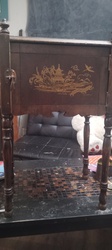
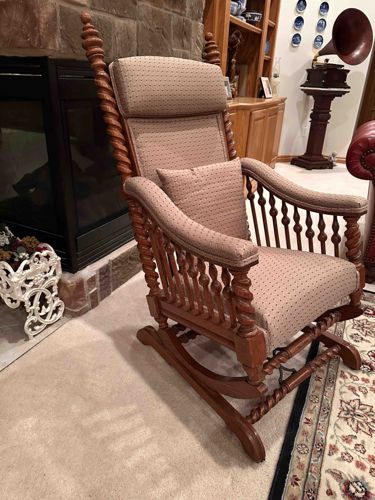
Platform Rocking Chair with Barley Twist Carvings

Antique Furniture

AI Estimated Value

·Not an official valuation·Verify before acting

$450 - $700

As of May 15, 2026

AI Item Analysis

·AI can make mistakes·Verify before acting
This is a Victorian-style platform rocking chair, likely a late 19th-century original or a high-quality mid-20th-century revival piece. The frame is constructed from a solid hardwood, possibly oak or walnut, featuring a medium honey-brown finish. The most striking physical characteristic is the extensive use of 'barley twist' or solomonic carvings on the vertical back supports, the lower leg stretchers, and the primary front supports. The chair back is exceptionally tall, terminating in decorative finials, and features an integrated padded headrest. The side panels beneath the armrests are composed of smaller, vertically oriented turned spindles. The chair sits on a stationary platform base with a spring-tension rocking mechanism, a design intended to prevent wear on carpets and keep the chair in a fixed position. The upholstery is a modern replacement, consisting of a neutral beige fabric with a small, repetitive geometric or 'dotted' pattern, including a matching lumbar pillow. The craftsmanship is evident in the precision of the spiral turnings and the sturdy joinery. Condition-wise, the wood appears well-maintained with a soft patina and no immediate signs of structural damage or significant scarring. The upholstery is clean and tight, suggesting it was professionally redone recently. This piece exemplifies the ornate, eclectic tastes of the late Victorian era, focusing on verticality and intricate woodwork.
AI Appraisal Report

·AI can make mistakes·Verify before acting
I have virtually examined this Victorian-style platform rocking chair. The piece displays hallmarks of the late 19th-century Aesthetic Movement, specifically the use of elaborate barley twist (solomonic) turnings. The transition from traditional rockers to a stationary platform base was a significant innovation of the 1870s-1880s, designed to protect carpets and prevent 'creeping.' The wood—likely walnut or stained oak—exhibits a warm patina consistent with age, and the joinery appears structurally sound. However, the modern beige upholstery and lumbar pillow, while clean and professionally executed, detract from the historical 'period' value for purist collectors who prefer original mohair or horsehair coverings. The market for Victorian furniture currently remains soft, as modern interior design trends favor minimalism. While the barley twist carvings add a 'premium' decorative element, the abundance of mass-produced revival pieces from the mid-20th century creates a ceiling on the valuation. Comparables for similar walnut platform rockers range from $300 for basic models to $900 for those with provenance or original needlepoint. Critically, this appraisal is based on photographic evidence. I cannot definitively confirm age without a physical inspection of the spring mechanism for patented manufacturer markings (such as Hunzinger or Heywood-Wakefield) or examining the underside for circular saw marks versus hand-planing. Verification of authenticity would require checking the joinery for hand-cut dovetails and inspecting the wood grain under magnification to rule out modern stains. Possession of provenance or an original bill of sale would significantly strengthen the valuation at the higher end of the provided range.

Get your items appraised

Instant estimates of your treasures with AI-powered appraisals

Browse More Appraisals