AI estimate as of August 1, 2025 · verify with a professional before acting
AI-Generated · Verify before acting
Everything on this page is generated by AI for informational purposes only. AI can make mistakes — the AI may misidentify items or misattribute them (artist, maker, brand, designer, origin, era). This is not an official valuation and should not be used for insurance, sale, tax, estate, legal, or lending purposes — or any decision requiring a certified appraisal. It is not an authoritative claim about any person, brand, or rights holder — do not share or rely on it as a factual statement about a third party. Always consult qualified professionals before making financial decisions.
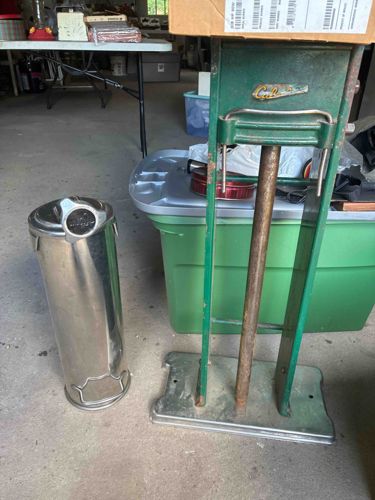
The item identified is a vintage or antique can crusher, likely designed for aluminum beverage cans. It features a sturdy construction primarily from metal, with a striking dark green painted finish on the main body. The base is an unpainted, possibly cast iron or heavy steel plate, providing stability, and it shows signs of wear including scuffs, scratches, and some surface rust, particularly on the vertical crushing rod. The crushing mechanism appears to be a lever-operated design, with a long, unpainted, rusty metal rod serving as the plunger that compresses the cans. The handle for operation is not fully visible but the crushing arm is clear. A prominent feature is the gold-colored, possibly brass or painted metal, embossed or raised lettering on the top section, which reads 'Cuda' or 'Cuba' (the 'b' is a bit ambiguous). This lettering suggests a brand name or model identifier. The overall condition indicates moderate to heavy use, with paint chipping, oxidation, and general wear consistent with its utilitarian purpose and age. The design suggests it dates from the mid-20th century, perhaps 1950s-1970s, a period when such manual processing tools were common. The craftsmanship appears robust, built for durability rather than intricate aesthetics, reflecting its functional design. The base has two visible circular indentations, possibly mounting holes, suggesting it could be bolted down for more stable operation. The entire piece exudes a vintage industrial charm.
AI Appraisal Report
Upon my virtual examination of this vintage can crusher, I observe it to be a robust, utilitarian household appliance, likely from the mid-20th century (1950s-1970s). Its construction, primarily of metal with a dark green painted finish and an unpainted base, suggests durability. The "Cuda" or "Cuba" embossed lettering is a key identifying feature, though its exact brand name remains ambiguous without clearer resolution. The item's condition shows moderate to heavy use—paint chipping, scuffs, surface rust on the crushing rod, and general wear are evident, consistent with its age and function. These signs of age and use contribute to its vintage charm but do affect its top-end collectible value.
In terms of authenticity, based solely on the image, the item appears genuinely vintage. Its design and materials align with manufacturing practices of the era. However, without a physical inspection, I cannot verify material composition (e.g., distinguishing brass from brass-painted metal), inspect for hidden repairs, or assess the integrity of the crushing mechanism. Furthermore, precise authentication of the "Cuda" or "Cuba" branding would require researching historical manufacturing records or consulting with collectors specializing in vintage household tools, as this particular brand is not immediately recognizable as a widely collected manufacturer.
Market conditions for vintage utility tools like can crushers are generally niche. While there's a steady demand from collectors of Americana, industrial design enthusiasts, or individuals seeking functional vintage items, these are not high-value collectibles unless associated with a highly renowned or rare manufacturer, or possessing exceptional design or historical significance. Comparables in similar condition typically fetch modest prices. Factors impacting value here include its sturdy construction, the clear, albeit ambiguous, branding, and its overall "industrial chic" aesthetic which appeals to decorators. The wear and surface rust, while indicative of age, detract slightly from its value as a display piece. Its functionality also cannot be verified from images alone.
Demand for such items is moderate. Rarity is difficult to ascertain without more information on the "Cuda/Cuba" brand; common can crushers are not rare. The primary factor limiting higher value is its condition and the lack of a prominent, highly collectible brand name. For full authentication, I would require in-person examination to inspect materials, assess mechanical function, and look for any manufacturer's marks or patent numbers. Provenance documentation, if available, would further solidify its history. Without these, my appraisal is based purely on visual assessment and general market trends for similar vintage utility items.