These notes were written by the person who submitted this item. Appraiser.AI has not verified them, and the AI's identification and estimate may rely on them.
AI Estimated Value
Not an official valuation
$75-150
AI estimate as of July 26, 2025 · verify with a professional before acting
AI-Generated · Verify before acting
Everything on this page is generated by AI for informational purposes only. AI can make mistakes — the AI may misidentify items or misattribute them (artist, maker, brand, designer, origin, era). This is not an official valuation and should not be used for insurance, sale, tax, estate, legal, or lending purposes — or any decision requiring a certified appraisal. It is not an authoritative claim about any person, brand, or rights holder — do not share or rely on it as a factual statement about a third party. Always consult qualified professionals before making financial decisions.
This analysis also relies on unverified notes provided by the user, which may be incomplete or inaccurate and could affect the result.
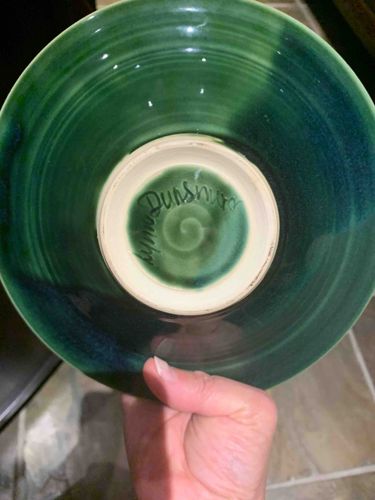
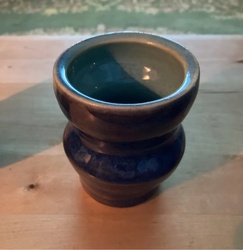
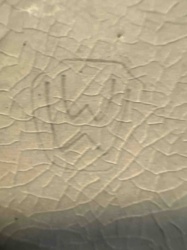
This item is a handcrafted ceramic bowl, distinguished by its vibrant, deep green glaze that transitions to a rich, darker teal or blueish-green hue in certain areas, particularly towards the bottom where the glaze appears thicker or pooled. The exterior surface of the bowl displays subtle concentric ridges, indicating that it was created on a potter's wheel, a common characteristic of thrown pottery. The glaze is glossy and reflective, showing several light reflections, suggesting a smooth, well-fired finish. The foot of the bowl is unglazed and reveals the natural, light cream or off-white color of the clay body, providing a contrast to the vivid glaze. Within this unglazed foot, there is a visible spiral mark, likely a tooling mark from the pottery process, and distinctly incised or penned lettering that reads 'Dunsburo' (or possibly 'Dunsbury' or 'Dunsbero' - the last letter is partially obscured but appears to be 'o' or an ambiguous character). Below this, another handwritten word, possibly 'Lynn' or 'Lynne', is visible, suggesting the potter's signature. The overall form appears functional, likely a serving bowl or decorative piece. The craftsmanship suggests a studio pottery piece rather than mass-produced ware, defined by the distinct glaze application and hand-signed maker's mark. There are no obvious signs of chips, cracks, or significant wear visible from this angle, though a full inspection would be required to confirm overall condition. The quality of the glaze and the evident hand-throwing indicate a relatively high level of skill in pottery. Without further context, the age is estimated to be late 20th century to early 21st century, typical of studio pottery.
AI Appraisal Report
Upon visual examination of this studio pottery bowl, I assess it to be a well-crafted piece, likely from the late 20th or early 21st century. The vibrant, layered green glaze, coupled with the clear throwing rings, indicates a skilled artisan. The bowl appears to be in excellent condition, with no visible chips, cracks, or crazing from the provided images. The signature incised into the unglazed foot, 'Dunsburo' and possibly 'Lynn', is the primary factor in determining its origin and value. Research into potters or studios named 'Dunsburo' or similar variations from pottery directories and sales archives is crucial. The current market for studio pottery is robust, particularly for signed pieces by recognized potters. Comparable works by lesser-known but skilled studio potters often sell in the $75 to $150 range. The value of this specific piece is highly dependent on identifying the maker. If 'Dunsburo' is a recognized and collected potter, the value could be significantly higher. Without this identification, it is valued as a decorative object of quality craftsmanship. A definitive valuation and authentication would require an in-person examination to assess the clay body, glaze texture, and weight, as well as thorough research into the signature to establish provenance. Verifying the signature against known examples from the potter is essential for full authentication, as forgeries of valuable studio pottery marks can exist.