AI Appraisal Estimate

AI-generated estimates · not official valuations

From the user

What was submitted

Photo and notes provided by the user — not generated by AI

Submitted item photo
Submitted photo · July 18, 2026

User's notes

No additional notes provided.

AI analysis below

AI appraisal

AI analysis & estimate

AI-Generated · Verify before acting

Everything below is generated by AI for informational purposes only. AI can make mistakes — the AI may misidentify items or misattribute them (artist, maker, brand, designer, origin, era). This is not an official valuation and should not be used for insurance, sale, tax, estate, legal, or lending purposes — or any decision requiring a certified appraisal. It is not an authoritative claim about any person, brand, or rights holder — do not share or rely on it as a factual statement about a third party. Always consult qualified professionals before making financial decisions.

Read the full disclaimer

AI Identification

·Not independently authenticated·Verify before acting

Mechanical cast iron bank in the style of the 'Trick Dog' design

Antique Toys and Banks

AI Estimated Value

·Not an official valuation·Verify before acting

$400 - $800

As of July 18, 2026

AI Item Analysis

·AI can make mistakes·Verify before acting
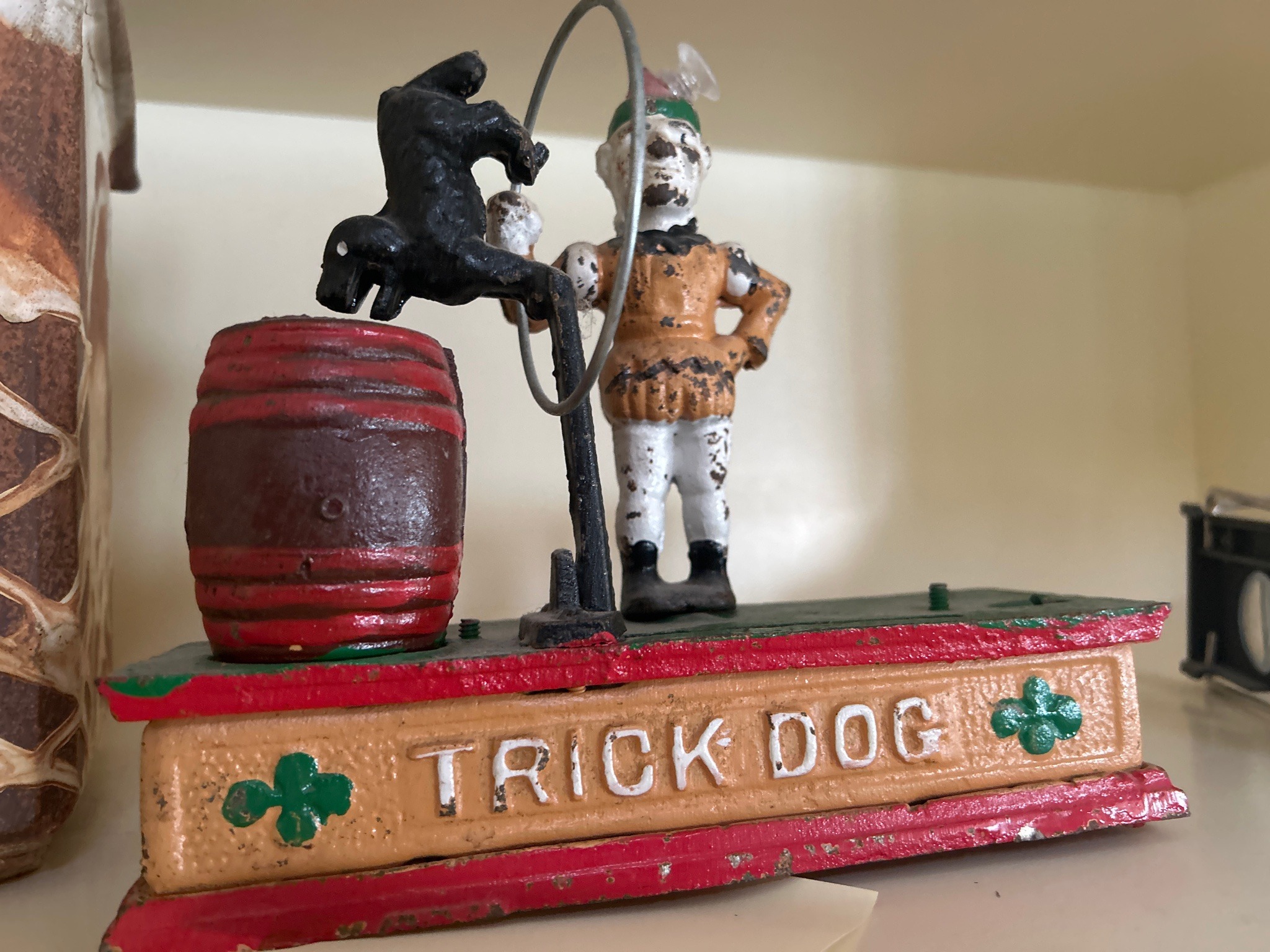
This item is a polychrome painted cast iron mechanical savings bank, featuring a black dog, a clown figure, and a barrel on a rectangular tiered base. The base prominently displays the raised text 'TRICK DOG' flanked by green four-leaf clover motifs. The design is stylistically consistent with late 19th-century mechanical banks, specifically the 'Trick Dog' model originally produced by the Hubley Manufacturing Co., though without a physical inspection of the underside for markings or casting quality, it is viewed here as a stylistic attribution. The bank is constructed of heavy metal components with visible seams. The color palette includes a red and brown barrel, a yellow and white clown with green accents, and a red and beige base. Notable condition issues include significant paint loss, chipping, and surface oxidation across all figures and the base, suggesting considerable age or simulated wear. The mechanical operation, which typically involves the dog jumping through the hoop to deposit a coin, cannot be verified from a still image. The identification is hedged because mass-produced reproductions of this specific design have been common since the mid-20th century, and the lack of visible foundry marks or distinctive fine casting details makes it impossible to distinguish an ensemble of original parts from a later reproduction through a photograph alone.

AI Appraisal Report

·AI can make mistakes·Verify before acting
I have examined the images of this polychrome painted cast iron 'Trick Dog' mechanical bank. Based on what I can see, the item features casting and paint wear patterns consistent with a vintage or antique object, though I cannot verify the specific age or foundry origin through a photograph. The value estimate is based on the hypothesis that this is a late 19th or early 20th-century piece attributed to the Hubley Manufacturing Co. or a contemporary period competitor. The market for mechanical banks remains active among collectors who prioritize paint quality and mechanical integrity. The visible surface oxidation and significant paint loss noted on the dog and clown figures negatively impact the valuation, as collectors typically seek examples with higher percentages of intact original pigment. I cannot verify the mechanical function or internal state of the mechanism from this image; a failure to operate would decrease the value significantly. If this item were determined to be a mid-20th-century reproduction or a modern 'in the style of' casting, the value would likely fall to $30 - $75. To confirm a more precise valuation, a physical inspection is required to analyze the quality of the iron casting, the presence of internal assembly marks, and the chemical composition of the paint. The current market for items of this type fluctuates based on the rarity of the specific color variant and the crispness of the casting details, which are difficult to assess without tactile evaluation. This estimate assumes the piece is a period example rather than a later copy.

Related Tags

Explore similar items and categories

Get your items appraised

Instant estimates of your treasures with AI-powered appraisals

Browse More Appraisals