AI estimate as of October 25, 2025 · verify with a professional before acting
AI-Generated · Verify before acting
Everything on this page is generated by AI for informational purposes only. AI can make mistakes — the AI may misidentify items or misattribute them (artist, maker, brand, designer, origin, era). This is not an official valuation and should not be used for insurance, sale, tax, estate, legal, or lending purposes — or any decision requiring a certified appraisal. It is not an authoritative claim about any person, brand, or rights holder — do not share or rely on it as a factual statement about a third party. Always consult qualified professionals before making financial decisions.
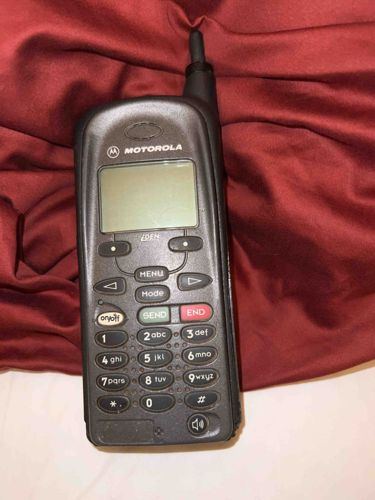
This item is an early model Motorola iDEN series cellular phone, likely an i85s or a closely related model from the late 1990s to early 2000s, characterized by its prominent external antenna, robust construction, and monochrome display. The phone is black and constructed from a durable plastic casing, suggesting it was designed for ruggedness and daily use. It features a visible Motorola logo and text above a rectangular, non-backlit LCD screen. Below the screen is a keypad consisting of tactile rubberized buttons, including standard alphanumeric keys (0-9, *, #), 'SEND' and 'END' call buttons (green and red respectively), 'MENU', 'Mode', and navigation keys (two triangular arrows and two circular buttons). A distinct 'on/off' button for the phone is also visible. The phone's design is typical of early digital cellular technology, with a noticeable external rubberized antenna projecting from the top right side. The overall condition appears used, with some visible dust accumulation in the crevices of the buttons and faint signs of wear on the plastic body, though no significant damage like cracks or deep scratches is apparent from the image. The buttons show some glossiness from frequent use. The ‘iDEN’ branding is clearly visible just below the screen, indicating its integration with Motorola's Integrated Digital Enhanced Network technology, which offered capabilities like two-way radio (walkie-talkie) functionality in addition to standard cellular service. This model represents a significant era in mobile communication, bridging traditional mobile phones with push-to-talk technology. Its utilitarian design emphasizes function over aesthetics, typical of the period.
AI Appraisal Report
Upon visual examination of this Motorola iDEN i85s (or similar iDEN series) flip phone, I can confirm its authenticity as an early digital cellular device from the late 1990s to early 2000s, consistent with Motorola's iDEN line. The visible Motorola branding, 'iDEN' text, distinct external antenna, robust black plastic casing, and specific button layout all align with known characteristics of these models. The condition appears to be used, with visible dust accumulation in crevices and some glossiness on frequently used buttons, indicating moderate prior use. However, I observe no significant damage such as cracks or deep scratches, which is positive for its value.
Market conditions for vintage cell phones generally vary wildly. While iconic or groundbreaking models can fetch high prices, more common utility-focused phones like this iDEN series typically appeal to a niche market of collectors, prop masters, or enthusiasts seeking nostalgia or specific functionalities (e.g., push-to-talk). Demand for this specific model, while present, is not exceptionally high. They are not particularly rare, given their widespread corporate and public safety use in their era.
Factors significantly impacting value include its good cosmetic condition despite use, and its representation of an important technological transition period (cellular with integrated walkie-talkie). However, its commonality, lack of 'iconic' status compared to models like the original iPhone or early StarTACs, and its utilitarian design limit its top-tier collector appeal.
Limitations in authenticity verification from images alone include the inability to test functionality (e.g., power-on, screen operation, button responsiveness), assess internal integrity, or verify if it's been tampered with. An in-person examination would allow for physical handling, functional testing, and closer inspection for hidden defects or restoration work, which would be crucial for a more precise valuation.