AI estimate as of October 27, 2025 · verify with a professional before acting
AI-Generated · Verify before acting
Everything on this page is generated by AI for informational purposes only. AI can make mistakes — the AI may misidentify items or misattribute them (artist, maker, brand, designer, origin, era). This is not an official valuation and should not be used for insurance, sale, tax, estate, legal, or lending purposes — or any decision requiring a certified appraisal. It is not an authoritative claim about any person, brand, or rights holder — do not share or rely on it as a factual statement about a third party. Always consult qualified professionals before making financial decisions.
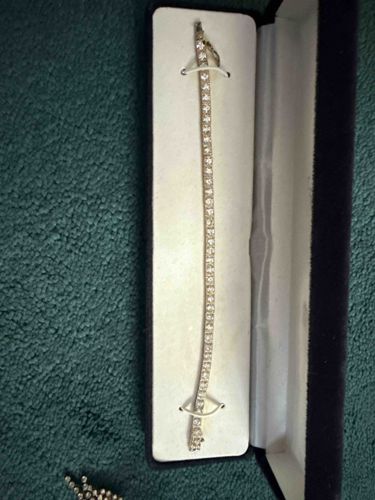
This is a diamond tennis bracelet, likely made of white gold, platinum, or sterling silver, given the silver-toned appearance of the metal. The bracelet features a continuous line of uniformly sized, round, brilliant-cut stones, most likely diamonds or cubic zirconia, individually set in what appears to be a four-prong setting for each stone. The stones are closely spaced, creating a flexible, sparkling band. The bracelet is displayed in an open black velvet or velour jewelry box with a cream or white satin-lined interior base, specifically designed with slots or clips to hold the bracelet in place. The overall length of the bracelet appears to be approximately 7 to 7.5 inches, a standard size for a tennis bracelet, and the width is fairly delicate, suggesting smaller carat weight stones, possibly around 0.10 to 0.20 carats each, though this cannot be confirmed without closer inspection. The clasp mechanism is not clearly visible but is likely a box clasp with a safety catch, typical for this style of bracelet. There appear to be no major visible condition issues such as missing stones or significant kinks in the metal from this image; however, closer inspection would be required to identify minor scratches, wear to the settings, or tarnishing on the metal. The style is classic and timeless, indicating it could range from a relatively modern production (late 20th century to present day) to a vintage piece, depending on the craftsmanship quality.
AI Appraisal Report
Based on my visual examination of the provided image, I assess this to be a diamond tennis bracelet, likely crafted from white gold, given the classic silver-toned appearance and the style of setting. The continuous line of uniformly sized, round brilliant-cut stones are consistent with diamonds, individually secured in what appears to be robust four-prong settings. The stones are closely spaced, forming a flexible and elegant band. The overall length of approximately 7 to 7.5 inches is standard. The individual stones appear to be in the 0.10 to 0.20 carat range, leading to a total carat weight (TCW) potentially between 3.0 to 5.0 carats, depending on the exact number and size of stones.
From the image, the bracelet appears to be in excellent condition, with no visible missing stones, kinks, or obvious damage. The metal has an attractive luster, and the settings appear intact. The presence of a dedicated jewelry box suggests it has been stored with care. The style is timeless, ensuring sustained demand. Current market conditions for diamond tennis bracelets, especially those with a decent total carat weight and good craftsmanship, remain strong, driven by their enduring popularity as both an everyday luxury item and a special occasion piece. Comparable new bracelets with similar perceived diamond quality and total carat weight in 14k or 18k white gold typically retail in the $2,500 to $8,000 range.
However, it is crucial to note the limitations of image-based appraisal. Authenticity of the diamonds and metal (e.g., natural diamonds vs. simulants, gold vs. sterling silver, and caratage of the gold) cannot be definitively confirmed without in-person examination. A gemological assessment is required to determine the 4 Cs (carat weight, cut, color, clarity) of the diamonds, which significantly impact value. Furthermore, a physical inspection would reveal any minor scratches, wear to the settings, or potential tarnishing not visible in the image. Provenance documentation (e.g., original sales receipt, previous appraisal certificates) would also be beneficial for full authentication and valuation. Therefore, the stated value represents my professional estimate assuming natural diamonds of commercial quality and white gold construction, but a definitive appraisal would necessitate physical inspection and testing.