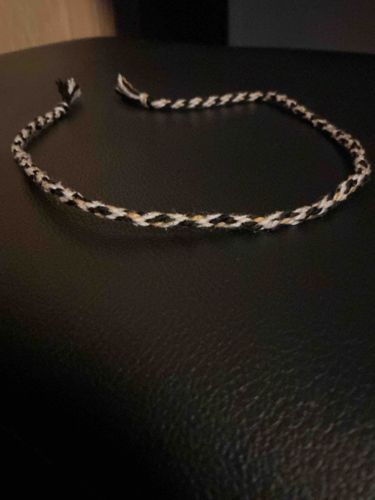
Handmade White, Black, and Gold Humikimo Bracelet (12 inches long)
These notes were written by the person who submitted this item. Appraiser.AI has not verified them, and the AI's identification and estimate may rely on them.
AI Estimated Value
Not an official valuation
$15-30
AI estimate as of November 22, 2025 · verify with a professional before acting
AI-Generated · Verify before acting
Everything on this page is generated by AI for informational purposes only. AI can make mistakes — the AI may misidentify items or misattribute them (artist, maker, brand, designer, origin, era). This is not an official valuation and should not be used for insurance, sale, tax, estate, legal, or lending purposes — or any decision requiring a certified appraisal. It is not an authoritative claim about any person, brand, or rights holder — do not share or rely on it as a factual statement about a third party. Always consult qualified professionals before making financial decisions.
This analysis also relies on unverified notes provided by the user, which may be incomplete or inaccurate and could affect the result.
This item is a handmade Humikimo bracelet, measuring approximately 12 inches in length. It is constructed from braided textile cords, specifically featuring a combination of white, black, and gold threads. The braiding technique appears to be a traditional Kumihimo style, which typically involves interlacing multiple strands to create a strong, visually intricate cord. The design exhibits a repeating pattern of white and black segments, with subtle hints of gold thread interwoven throughout, providing a delicate metallic shimmer. The overall texture of the bracelet is slightly coarse, consistent with natural or synthetic fiber threads. Both ends of the bracelet are finished with simple knots, indicating that it is designed to be tied around the wrist or ankle, rather than featuring a clasp mechanism. There are no discernible maker's marks or signatures, suggesting it is either an artisanal piece or a casual craft item. The condition appears good, with no visible fraying, breaks, or significant wear on the braided structure. The colors are generally vibrant, though the black might show some very minor fading if subjected to prolonged use or sun exposure over time. The craftsmanship appears consistent and even, suggesting a practiced hand in its creation. Its style is contemporary folk or bohemian, suitable for casual wear.
AI Appraisal Report
Based on my examination of the image and the provided details, this Handmade White, Black, and Gold Kumihimo Bracelet appears to be in good condition. There are no visible signs of fraying, breaks, or excessive wear on the braided structure. The colors seem vibrant, consistent with a well-maintained textile piece. The craftsmanship, characterized by the even and consistent braiding, suggests a practiced hand, though it lacks the intricate complexity that would significantly elevate its value. Authenticity, in this context, refers to it being genuinely handmade as described, which is plausible given the visible weaving structure.
Market conditions for handmade textile jewelry, particularly Kumihimo style bracelets without precious metal components or gemstone accents, are generally within the affordable artisanal craft segment. Comparable items, often found in online craft marketplaces or local fairs, typically retail in the $10-$40 range. Demand for such pieces is moderate, driven by casual wearers interested in bohemian or folk aesthetics. Rarity is not a significant factor; while each handmade piece is unique, the Kumihimo technique is well-known and widely practiced.
Factors significantly impacting value include the handmade nature and the apparent good condition. However, the absence of precious materials, a recognized maker, or a sophisticated design limits its upper valuation. The simple knotted ends also position it as a more casual, accessible item.
It is crucial to note the limitations of image-based appraisal. While the visual evidence supports a handmade origin, a physical inspection would be necessary to confirm the exact fiber composition (natural vs. synthetic) and to assess tactile quality. Without provenance documentation, full authentication of a specific maker or origin beyond 'handmade' is impossible. Scientific testing, such as fiber analysis, is not typically employed for items in this value range but could further confirm material composition if deemed necessary for highly contentious cases.