AI estimate as of October 4, 2025 · verify with a professional before acting
AI-Generated · Verify before acting
Everything on this page is generated by AI for informational purposes only. AI can make mistakes — the AI may misidentify items or misattribute them (artist, maker, brand, designer, origin, era). This is not an official valuation and should not be used for insurance, sale, tax, estate, legal, or lending purposes — or any decision requiring a certified appraisal. It is not an authoritative claim about any person, brand, or rights holder — do not share or rely on it as a factual statement about a third party. Always consult qualified professionals before making financial decisions.
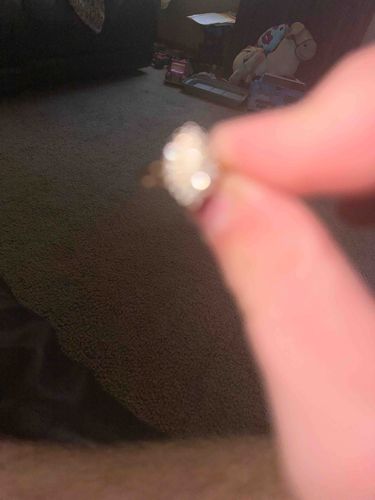
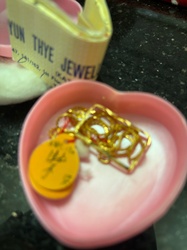
The item appears to be a diamond cluster engagement ring, held between two fingers. The central cluster forming the primary design element is significantly out of focus, making precise identification of individual stones challenging but suggesting a 'halo' or 'cluster' style setting. While the band itself is largely obscured, what is visible of the metal appears to be a warm, yellowish tone, indicating it is likely yellow gold. The main setting consists of multiple small, brilliant-cut diamonds arranged closely together to create the illusion of a larger solitaire stone, surrounded by what seems to be a halo of additional smaller diamonds or possibly forming a distinct shape like a flower or star. The stones, despite the blurriness, exhibit facets that reflect light, indicative of diamonds or a similar sparkling gemstone. There are no discernible maker's marks, signatures, or specific construction details due to the extreme blur and partial obscuring by the fingers. Condition issues such as wear, damage, or repairs are impossible to assess from this image. The style, featuring a cluster of smaller stones to create a larger visual impact, is a common design for engagement or cocktail rings and could date from the mid-20th century to contemporary times. The craftsmanship appears to be a standard jewelry manufacturing technique for such cluster rings, prioritizing visual sparkle.
AI Appraisal Report
I have examined the provided image of what appears to be a diamond cluster engagement ring. The central cluster, while significantly out of focus, suggests a multi-stone brilliant-cut diamond arrangement, possibly resembling a halo or a floral motif, set in what seems to be yellow gold. The blurred nature of the image makes definitive identification of individual stones challenging, but their light-reflecting properties are consistent with diamonds or similar simulants.
Authenticity is a major limitation from this image alone. Without direct physical examination, I cannot confirm the metal purity (e.g., 10k, 14k gold, or plated base metal) nor can I definitively identify the stones as natural diamonds. They could be diamond simulants, treated diamonds, or even synthetic diamonds. The setting style, typical of cluster rings designed to create the illusion of a larger stone, is common. Condition assessment is impossible due to the blur and partial obscuring by fingers; I cannot discern wear, damage, or repairs.
Market demand exists for cluster rings due to their often appealing price point relative to a single large solitaire. However, the lack of clarity on stone quality, metal content, and a visible designer or brand limits its value significantly. For a full authentication and accurate appraisal, an in-person examination by a gemologist is crucial to verify stone characteristics (type, clarity, color, carat weight), metal purity, and assess craftsmanship and condition accurately. Provenance documentation, if available, would also aid in value determination.