AI estimate as of December 13, 2025 · verify with a professional before acting
AI-Generated · Verify before acting
Everything on this page is generated by AI for informational purposes only. AI can make mistakes — the AI may misidentify items or misattribute them (artist, maker, brand, designer, origin, era). This is not an official valuation and should not be used for insurance, sale, tax, estate, legal, or lending purposes — or any decision requiring a certified appraisal. It is not an authoritative claim about any person, brand, or rights holder — do not share or rely on it as a factual statement about a third party. Always consult qualified professionals before making financial decisions.
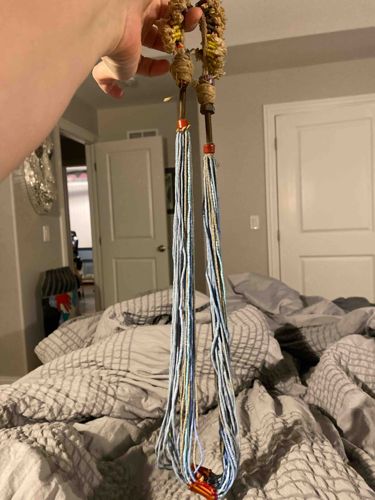
This item is a multi-strand necklace, likely handmade, characterized by a unique combination of natural and manufactured components. The upper portion of the necklace consists of what appear to be irregular, textured, and possibly dried or preserved natural elements, such as seed pods, small pine cones, or woven plant fibers. These elements are a light brown to yellow-brown color, exhibiting a rustic and organic aesthetic. They are strung together, possibly on a thick cord or wire, forming a somewhat bulky and textured section. Below these natural elements, the necklace transitions into long, flowing tassels composed of numerous finely strung seed beads. There are at least two distinct tassels, each comprising many individual strands. The seed beads predominantly display a delicate color palette of light blue, white, and possibly pale yellow or gold, creating a soft, ethereal effect. Interrupting the connection between the natural elements and the seed bead tassels are small, cylindrical, dark brown or black beads, possibly made of wood or a similar natural material, followed by smaller, bright orange or coral-colored barrel-shaped beads, which add a vibrant accent. The ends of the seed bead strands appear to be gathered and secured, potentially with similar small orange beads, forming a coherent tassel. The craftsmanship suggests a folk art or tribal origin, emphasizing natural materials and intricate beadwork. The overall condition appears good, with no obvious signs of significant damage or breakage, although the natural elements may show inherent variations and minor wear consistent with their organic nature. The style leans towards a bohemian or ethnic aesthetic, likely dating from the late 20th century to contemporary. The visible construction suggests a durable assembly, though the fineness of the seed beads warrants careful handling.
AI Appraisal Report
Upon visual examination of the Multi-Strand Seed Bead Necklace with Natural Elements, I assess its condition as good. The natural elements, likely seed pods or woven plant fibers, appear intact with expected organic variations and no signs of significant breakage. The seed bead tassels, predominantly in light blue, white, and pale yellow/gold, appear well-preserved, and the intricate stringing seems secure. The dark brown cylindrical beads and bright orange barrel-shaped beads provide interesting accents and appear to be in good order.
Authenticity, based solely on imagery, suggests a handmade piece with a folk art or bohemian aesthetic. The combination of natural elements with detailed beadwork is consistent with late 20th to contemporary artisan jewelry. Market conditions for such items vary widely. Comparables for similar multi-strand, natural element, and seed bead necklaces in a bohemian or ethnic style typically range from $40 for simpler pieces to $150 or more for artist-signed or exceptionally unique examples. Demand is niche but consistent among collectors of artisanal, handmade, or ethnic-inspired jewelry. The rarity of this specific design is difficult to ascertain without knowing its maker or origin, but the individual components are not inherently rare.
Factors significantly impacting value include the quality of craftsmanship, especially the meticulousness of the seed bead stringing and the condition of the natural elements. The perceived age and maker (if identifiable) would also play a role. Limitations in authenticity verification from images alone are significant. I cannot definitively confirm the materials used for the 'natural elements' (e.g., specific plant species). Without in-person examination, it's impossible to assess the weight, tactile quality, or precise construction methods (e.g., knotting, type of stringing material). Provenance documentation would be crucial to attribute the piece to a specific artist or region, significantly impacting its value. Scientific testing could verify material composition if needed, but is unlikely for an item of this type unless concerns about rare or precious materials arose.