AI Appraisal Estimate

AI-generated estimates · not official valuations

From the user

What was submitted

Photo and notes provided by the user — not generated by AI

Submitted item photo
Submitted photo · May 27, 2026

User's notes

No additional notes provided.

AI analysis below

AI appraisal

AI analysis & estimate

AI-Generated · Verify before acting

Everything below is generated by AI for informational purposes only. AI can make mistakes — the AI may misidentify items or misattribute them (artist, maker, brand, designer, origin, era). This is not an official valuation and should not be used for insurance, sale, tax, estate, legal, or lending purposes — or any decision requiring a certified appraisal. It is not an authoritative claim about any person, brand, or rights holder — do not share or rely on it as a factual statement about a third party. Always consult qualified professionals before making financial decisions.

Read the full disclaimer

AI Identification

·Not independently authenticated·Verify before acting

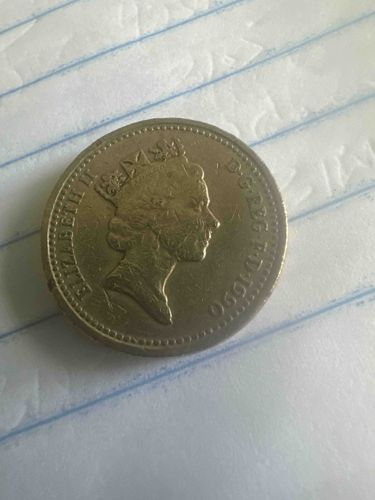
British One Pound Coin (1990, Elizabeth II)

Coin

AI Estimated Value

·Not an official valuation·Verify before acting

$2-5

As of May 27, 2026

AI Item Analysis

·AI can make mistakes·Verify before acting
The item is a British One Pound coin, specifically dating from 1990, as indicated by the inscription '1990' visible on the obverse. The coin features the effigy of Queen Elizabeth II, facing right, wearing a crown. Her hair and the details of the crown are clearly discernible, though there's some slight wear on the highest points of the relief due to circulation. The inscription surrounding the effigy reads 'ELIZABETH II D G REG F D 1990'. The 'D G REG F D' stands for 'Dei Gratia Regina Fidei Defensor', which translates to 'By the Grace of God, Queen, Defender of the Faith'. The coin appears to be made of a yellow-colored metal, likely nickel brass, which was the standard composition for the one-pound coin at that time. The edge of the coin features a series of small, uniform dots creating a border around the central design, indicating an evenly milled rim. There is some minor surface scratching and general wear consistent with a coin that has been in circulation but no significant damage like deep gouges or bends. The patina is even, suggesting no harsh cleaning has taken place. The overall impression is that of a well-preserved circulated coin, reflecting standard Royal Mint quality and craftsmanship for its era.

AI Appraisal Report

·AI can make mistakes·Verify before acting
I have examined the provided image of the British One Pound coin, dated 1990, featuring Queen Elizabeth II. Based on the visual information, the coin appears to be authentic, consistent with known Royal Mint designs and specifications for the 1990 one-pound issue. The effigy of Elizabeth II, the 'ELIZABETH II D G REG F D 1990' inscription, and the milled rim with uniform dots are all accurate to this type. Regarding condition, I assess this coin to be in a Very Fine (VF) to Extremely Fine (EF) state. While there is visible minor surface scratching and some slight wear on the highest points of the Queen's effigy and crown, consistent with circulation, it retains good detail. The even patina suggests no harsh cleaning has occurred, which is positive for value preservation. There are no signs of significant damage like deep gouges or bends. From a market perspective, 1990 British One Pound coins are very common. Millions were minted and many remain in circulation or in collections. Demand for circulated examples is generally low, primarily driven by novice collectors filling date sets or individuals seeking a specific 'birth year' coin. Higher demand exists for uncirculated (BU) examples, but this coin clearly shows signs of wear. Factors significantly impacting value are the common mintage and the circulated condition. Rarity is not a factor here. For comparison, a typical circulated 1990 one-pound coin normally trades for little more than its face value. Even in better circulated grades, the market value remains modest. It is important to note the limitations of this appraisal. While the image strongly suggests authenticity, a definitive verification requires physical inspection. I would need to examine the coin firsthand to verify its weight, diameter, thickness, and metallic composition (nickel brass), and to scrutinize the edge inscription (which is not visible in the provided description) to rule out any sophisticated counterfeits. Physical examination also allows for a more precise grading of the surface luster and minute details that may not be fully captured in an image. Provenance documentation could also add to certainty, though for such a common coin, it is rarely available or necessary beyond basic physical checks.

Get your items appraised

Instant estimates of your treasures with AI-powered appraisals

Browse More Appraisals