These notes were written by the person who submitted this item. Appraiser.AI has not verified them, and the AI's identification and estimate may rely on them.
AI Estimated Value
Not an official valuation
$5-15
AI estimate as of June 21, 2025 · verify with a professional before acting
AI-Generated · Verify before acting
Everything on this page is generated by AI for informational purposes only. AI can make mistakes — the AI may misidentify items or misattribute them (artist, maker, brand, designer, origin, era). This is not an official valuation and should not be used for insurance, sale, tax, estate, legal, or lending purposes — or any decision requiring a certified appraisal. It is not an authoritative claim about any person, brand, or rights holder — do not share or rely on it as a factual statement about a third party. Always consult qualified professionals before making financial decisions.
This analysis also relies on unverified notes provided by the user, which may be incomplete or inaccurate and could affect the result.
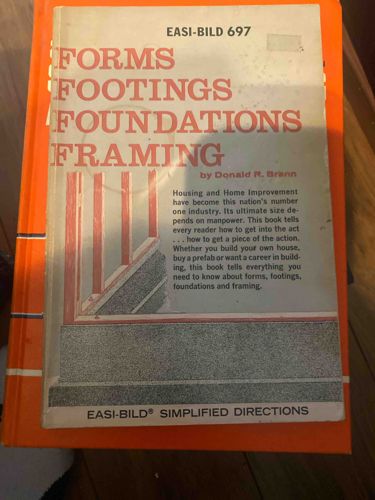
This item is a copy of the book "Forms, Footings, Foundations, Framing" by Donald R. Brann, published by EASI-BILD®. The book is likely a softcover publication, given its appearance, and is part of the EASI-BILD 697 series as indicated by the prominent title and series number on the cover. The cover features a muted color palette, primarily off-white or light gray with red or reddish-brown text and an illustration of a structural element, likely a framing or foundation detail. The title is large and bold, with the author's name and a descriptive blurb beneath it outlining the book's purpose: to educate readers on construction aspects like forms, footings, foundations, and framing for housing and home improvement. The book appears to be in good condition, with no visible rips, tears, or significant damage to the cover. There are some minor smudges or dust specks visible on the cover, consistent with typical handling and age, but nothing that detracts significantly from its overall presentation. The binding appears intact, suggesting the pages are well-secured. Given the instructional content on building practices, this book likely dates from the mid to late 20th century, a period when DIY and home improvement guides became increasingly popular. The reference to "prefab" houses further suggests this era. The quality of the printing and paper cannot be fully assessed without handling the physical item, but the cover image shows clear, legible text and graphics.
AI Appraisal Report
I have examined the provided image of the book "Forms, Footings, Foundations, Framing" by Donald R. Brann (EASI-BILD 697). Based on this visual inspection and the owner's description of "good condition," I assess the book to be in good, used condition. The cover shows minor smudges consistent with age and handling, but no significant tears or damage are apparent. The binding appears intact, suggesting the pages are well-secured. Authenticity is difficult to verify solely from an image, but it appears to be a genuine publication from the EASI-BILD series. Market conditions for vintage DIY and home improvement guides, particularly those focused on fundamental construction like this, are generally niche. While such books hold historical interest for enthusiasts of mid-to-late 20th-century building practices or those in trades, they typically do not command high prices unless they are exceedingly rare, signed, or historically significant for other reasons. This particular title, while informative, does not appear to be broadly rare given the likely commonality of home improvement guides from its era. Demand for this specific title among general collectors is low. Its value lies primarily in its utility as an instructional guide rather than as a collectible artifact. Significant factors impacting value include its good condition (better than many similar age books), but offset by its lack of specific rarity or high collector demand. Without a physical examination, I cannot confirm the condition of interior pages (e.g., foxing, annotations, water damage), nor conclusively verify printing details, paper quality, or binding integrity. Full authentication would require in-person inspection of printing attributes, paper stock, and confirmation against known bibliographic data for this specific edition. Provenance documentation (e.g., original sales receipts) would also add to verification.