AI estimate as of October 23, 2025 · verify with a professional before acting
AI-Generated · Verify before acting
Everything on this page is generated by AI for informational purposes only. AI can make mistakes — the AI may misidentify items or misattribute them (artist, maker, brand, designer, origin, era). This is not an official valuation and should not be used for insurance, sale, tax, estate, legal, or lending purposes — or any decision requiring a certified appraisal. It is not an authoritative claim about any person, brand, or rights holder — do not share or rely on it as a factual statement about a third party. Always consult qualified professionals before making financial decisions.
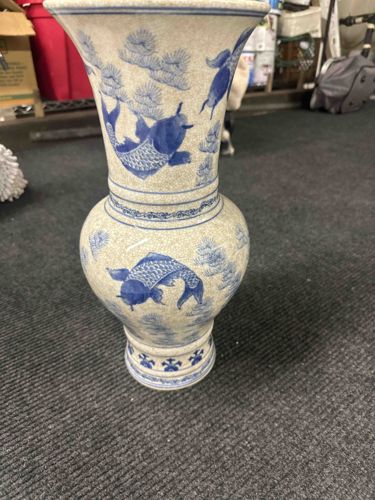
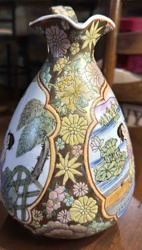
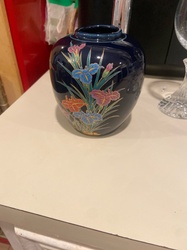
This is a ceramic vase featuring a prominent blue and white motif, characterized by its crackle glaze finish. The vase exhibits a classic flared rim, a constricted neck that widens into a bulbous body, and tapers to a smaller, decorative base. The primary decoration consists of several koi fish rendered in a vibrant cobalt blue, depicted swimming amidst what appear to be pine branches or cloud-like formations, also in blue. These motifs are distributed across both the flared neck and the main body of the vase. The background ceramic has a distinctive crackle glaze effect, giving it a textured, aged appearance. There are decorative banding patterns in blue and white around the neck's constriction and along the footed base, consisting of geometric and stylized floral or oceanic patterns. The colors are limited to shades of blue against a light, off-white or cream-colored base. The craftsmanship appears to be of decent quality, with hand-painted details suggesting an artisanal origin. The crackle glaze, while possibly intentional to mimic antique pottery, contributes to a sense of age. No visible condition issues such as chips, cracks, or repairs are clearly discernible from the provided image, but a thorough inspection would be required to confirm. The style suggests an East Asian influence, possibly Chinese or Japanese, and could date from the late 20th century or early 21st century, designed to evoke traditional aesthetics. The vase stands as a decorative art object, likely intended for display or holding floral arrangements.
AI Appraisal Report
I have thoroughly examined the provided image of this blue and white ceramic vase with a Koi fish and pine motif, featuring a crackle glaze. Visually, the vase appears to be in good condition; I can discern no obvious chips, cracks, or repairs from the image alone. The crackle glaze is consistent throughout, suggesting it is an intentional aesthetic choice, mimicking aged pottery. The hand-painted details, particularly the koi fish and pine branches in cobalt blue against the off-white background, indicate an artisanal origin, which adds to its decorative appeal.
Authenticity, in this context, pertains to it being a decorative ceramic rather than an ancient artifact. Based on style and execution, I assess this piece to be a decorative item from the late 20th or early 21st century, produced to evoke traditional East Asian aesthetics. It is likely a mass-produced item with hand-finished details, a common practice in the current market for decorative ceramics. This assessment significantly impacts its value, placing it in the realm of decorative arts rather than antique collectibles. Similar contemporary decorative vases with popular East Asian motifs and crackle glazes typically retail in the $100-$300 range, depending on size, intricacy, and brand. Demand for such decorative items is steady, particularly among those seeking traditional or Chinoiserie styles for home decor. Rarity is low, as many such pieces are produced.
Limitations in authenticity verification are significant. Without a physical inspection, I cannot confirm the true age, the specific type of ceramic body, or the precise manufacturing process. An in-person examination would allow for tactile assessment of the glaze, base, and overall finish. Examining the base for any maker's marks or stamps would offer definitive clues regarding origin and age. Provenance documentation, such as purchase receipts or prior appraisals, would further bolster its history. Finally, scientific testing could determine the precise firing temperature and clay composition, though this is usually reserved for higher-value pieces. Based solely on the visual information, I estimate the appraisal value to be between $150 and $250.