Plankenhammer Floss Bavaria Gilded Porcelain Saucer
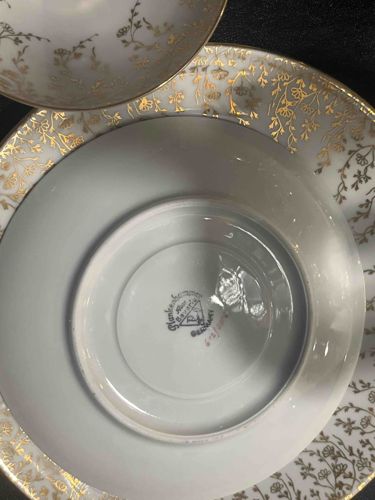
This is a fine porcelain saucer manufactured by the Plankenhammer factory in Floss, Bavaria, Germany. The piece is crafted from translucent white hard-paste porcelain, featuring a sophisticated gilt decoration. The pattern consists of delicate, etched or transfer-printed gold floral sprigs and vines that encircle the rim and transition toward the center. The scalloped rim is finished with a heavy gold gilt edge, also known as a 'gold encrusted' border. On the underside, the clear backstamp features the Plankenhammer crest with 'Bavaria' and 'Germany' designations, along with a hand-painted red alphanumeric decorator's mark (possibly '612/00'). The craftsmanship indicates a mid-20th-century production, likely between the 1930s and 1950s. The condition appears excellent with minimal visible wear to the gilding, no apparent chips, cracks, or crazing, and a high-gloss glaze finish that suggests well-preserved cabinet quality. The intricate gold work exhibits high-level detail, typical of German porcelain standards during this period.
AI-Generated Appraisal Disclaimer
Estimated Value
$45.00 - $65.00
Basic Information
Category
Antique/Vintage Tableware and Porcelain
Appraised On
February 23, 2026
Estimated Value
$45.00 - $65.00
Item Description
This is a fine porcelain saucer manufactured by the Plankenhammer factory in Floss, Bavaria, Germany. The piece is crafted from translucent white hard-paste porcelain, featuring a sophisticated gilt decoration. The pattern consists of delicate, etched or transfer-printed gold floral sprigs and vines that encircle the rim and transition toward the center. The scalloped rim is finished with a heavy gold gilt edge, also known as a 'gold encrusted' border. On the underside, the clear backstamp features the Plankenhammer crest with 'Bavaria' and 'Germany' designations, along with a hand-painted red alphanumeric decorator's mark (possibly '612/00'). The craftsmanship indicates a mid-20th-century production, likely between the 1930s and 1950s. The condition appears excellent with minimal visible wear to the gilding, no apparent chips, cracks, or crazing, and a high-gloss glaze finish that suggests well-preserved cabinet quality. The intricate gold work exhibits high-level detail, typical of German porcelain standards during this period.
Get Your Items Appraised
Instant estimates of your treasures with AI-powered instant appraisals