AI estimate as of August 2, 2025 · verify with a professional before acting
AI-Generated · Verify before acting
Everything on this page is generated by AI for informational purposes only. AI can make mistakes — the AI may misidentify items or misattribute them (artist, maker, brand, designer, origin, era). This is not an official valuation and should not be used for insurance, sale, tax, estate, legal, or lending purposes — or any decision requiring a certified appraisal. It is not an authoritative claim about any person, brand, or rights holder — do not share or rely on it as a factual statement about a third party. Always consult qualified professionals before making financial decisions.
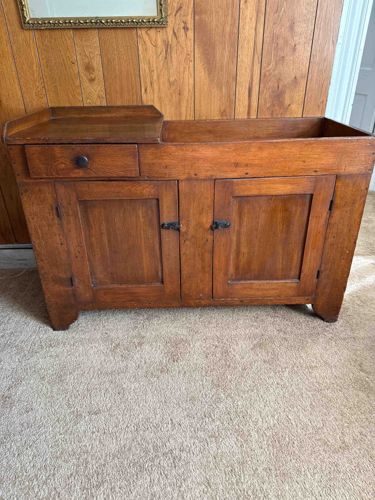
This appears to be an antique or vintage dry sink, a utilitarian piece of furniture traditionally used in kitchens before the advent of indoor plumbing. It is constructed primarily from a medium-toned wood, likely oak or pine, given its grain and the reddish-brown hue which suggests an aged finish or stain. The overall construction appears robust and is characterized by a rectangular form with a raised back and sides creating an open basin area on the right side of the top surface. To the left, there is a smaller, elevated compartment, possibly for holding a pitcher or other items, flanked by a single drawer underneath it, fitted with a dark, possibly wooden or ceramic, knob. The lower section of the dry sink features two cabinet doors, likely providing storage space. These doors are simple in design, having recessed panels, and are secured by dark, wrought-iron or cast-iron lift-off hinges, indicative of period craftsmanship. The visible wear includes slight scratches and superficial imperfections consistent with age and use, contributing to its patina. The corners of the base are cut in a simple bracket foot style. The rustic appeal, dark hinges, and practical design suggest a utilitarian piece from the late 19th to early 20th century, possibly of American folk or country style. There are no obvious maker's marks or signatures visible from the provided image, but the joinery and overall construction quality appear solid, with visible dowels or pegs on the top surface suggesting traditional construction methods.
AI Appraisal Report
Upon visual examination of this antique wooden dry sink, I've assessed its condition as good, commensurate with age and use. The visible wear, including slight scratches and superficial imperfections, is consistent with a utilitarian piece of this vintage and contributes to its desirable patina. Authenticity, based on design elements like the raised back and sides, the basin area, simple bracket feet, and particularly the dark wrought-iron or cast-iron lift-off hinges, strongly suggests an authentic late 19th to early 20th-century piece, likely American folk or country style. The construction appears solid, with visible dowels or pegs hinting at traditional joinery.
Market conditions for antique kitchen utility pieces like dry sinks remain steady, especially for those exhibiting good original condition and rustic charm. Comparables in the current market, particularly those with an appealing wood tone and period hardware, typically range from $600 to $1,200 depending on size, specific features, and regional demand. While not exceedingly rare, well-preserved examples like this one are always in demand among collectors of Americana, rustic furniture, or those seeking unique items for farmhouse decor. The absence of obvious repairs or significant damage enhances its value.
Limitations in authenticity verification from images alone are crucial to note. Without in-person examination, I cannot definitively confirm the wood species, assess the integrity of all joinery, or determine if any finishes are original or later additions. A physical inspection would allow me to check for hidden repairs, confirm the material of the knob, and properly evaluate the stability of the structure. Provenance documentation, though not always available for such pieces, could provide definitive history. Scientific testing, such as wood dating, would be excessive for a piece of this type and value, and is generally reserved for items of higher historical or monetary significance.