AI Appraisal Estimate

AI-generated estimates · not official valuations

From the user

What was submitted

Photo and notes provided by the user — not generated by AI

Submitted item photo
Submitted photo · June 2, 2026

User's notes

Gold coin

AI analysis below

AI appraisal

AI analysis & estimate

AI-Generated · Verify before acting

Everything below is generated by AI for informational purposes only. AI can make mistakes — the AI may misidentify items or misattribute them (artist, maker, brand, designer, origin, era). This is not an official valuation and should not be used for insurance, sale, tax, estate, legal, or lending purposes — or any decision requiring a certified appraisal. It is not an authoritative claim about any person, brand, or rights holder — do not share or rely on it as a factual statement about a third party. Always consult qualified professionals before making financial decisions.

Note

This analysis also relies on unverified notes provided by the user, which may be incomplete or inaccurate and could affect the result.

Read the full disclaimer

AI Identification

·Not independently authenticated·Verify before acting

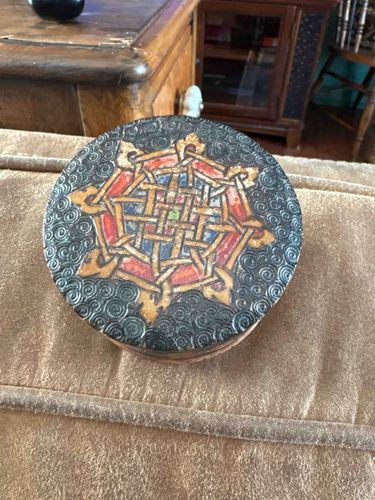
Hand-Painted Circular Wooden Trinket Box with Celtic Knotwork

Decorative Arts & Collectibles

AI Estimated Value

·Not an official valuation·Verify before acting

$45.00-$75.00

As of June 2, 2026

AI Item Analysis

·AI can make mistakes·Verify before acting
This item is a small, hand-crafted circular lidded box, likely constructed from a solid light-colored hardwood. The lid features a complex decorative program consisting of a central interlaced Celtic knot, or Solomon’s knot variation, highlighted in red, blue, and gold-tone pigments. This central geometric motif is set against a deeply textured, dark charcoal or black background displaying a dense pattern of incised concentric circles and whorl-like filigree. The carving appears to be relief-work or pyrography covered with a protective finish. The object displays signs of age and handled use, including minor pigment loss on the raised portions of the knotwork, softening of the edges, and a gentle patina across the base. The construction shows a friction-fit lid typical of mid-20th-century artisan craftwork or folk art traditions. The quality indicates a skilled hand, particularly in the symmetry of the interlace and the consistency of the hand-carved background texturing. There are no visible maker's marks or signatures on the upper surface, suggesting it may be an unsigned piece of decorative folk art or a boutique souvenir piece.

AI Appraisal Report

·AI can make mistakes·Verify before acting
Based on my examination of this hand-painted circular wooden trinket box, I have assessed it as a piece of 20th-century folk art, likely originating from a Celtic or Northern European craft tradition. The piece demonstrates high-quality artisan skill, specifically in the relief-carved background and the symmetry of the hand-painted Solomon’s knot. The condition is consistent with age; the minor pigment loss and softening of the wood grain provide a desirable patina that suggests genuine use rather than modern mass-production. The lack of a signature suggests it was produced as a high-end boutique souvenir or by an independent craftsman. In the current market for decorative arts, small, functional wooden boxes with specific cultural motifs maintain steady demand among collectors of folk art and treen. Comparable sales for unsigned mid-century Celtic-themed boxes typically fall within the $40 to $80 range, depending on the wood type and complexity of the carving. The mention of a 'gold coin' by the owner, if included or housed within the box as part of its provenance, could significantly increase the value based on the coin's weight and purity; however, this appraisal covers the box as a standalone decorative object. Limitations: This evaluation is based on visual analysis of the materials and decorative techniques. A physical inspection would be required to identify the specific wood species and verify if the patterns were achieved through hand-carving or pyrography. To confirm a more specific origin or a specific artist, provenance documentation or a maker's mark on the underside (not visible in the provided description) would be necessary. Scientific testing of the pigments could also determine the exact era of production.

Get your items appraised

Instant estimates of your treasures with AI-powered appraisals

Browse More Appraisals