AI estimate as of December 16, 2025 · verify with a professional before acting
AI-Generated · Verify before acting
Everything on this page is generated by AI for informational purposes only. AI can make mistakes — the AI may misidentify items or misattribute them (artist, maker, brand, designer, origin, era). This is not an official valuation and should not be used for insurance, sale, tax, estate, legal, or lending purposes — or any decision requiring a certified appraisal. It is not an authoritative claim about any person, brand, or rights holder — do not share or rely on it as a factual statement about a third party. Always consult qualified professionals before making financial decisions.
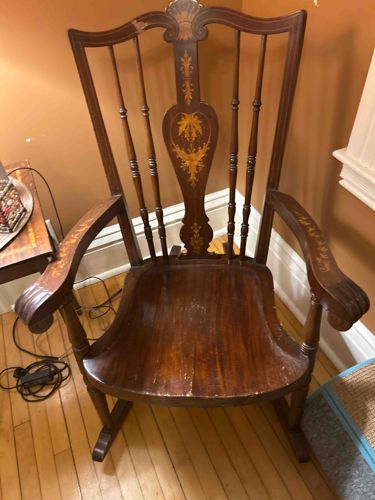
This is an antique or vintage rocking chair, likely dating from the late 19th to early 20th century, possibly in the Victorian or early American Colonial Revival style, with strong characteristics pointing towards a 'Grand Rapids' style of furniture. It is constructed primarily from a dark-stained wood, possibly mahogany or a similar hardwood, with a rich, reddish-brown finish. The chair features an elaborate carved top rail with a scallop shell motif at its center, flanked by gently curving shoulders. The backrest is composed of multiple turned spindles and a prominent central splat with intricate marquetry or inlay work depicting stylized floral or foliate designs in lighter woods, contrasting beautifully with the darker main wood. Similar inlay details are present on the curved arms of the chair. The seat is a solid, sculpted plank of wood, displaying natural wood grain, and appears to be curved for comfort. The legs transition into rocker runners, typical of a rocking chair, which are not fully visible in the image but are implied by the form. Visible condition issues include significant wear to the finish on the seat, where lighter patches indicate loss of varnish or stain, and some scuffing or minor damage on the top rail. There are also visible dust accumulation and general signs of age and use. The craftsmanship, particularly the detailed inlay work and turned elements, suggests a piece of good quality, manufactured with attention to decorative detail, consistent with the furniture production centers of the era such as Grand Rapids that specialized in ornate furniture.
AI Appraisal Report
This Inlaid Victorian Grand Rapids Style Rocking Chair, likely late 19th to early 20th century, exhibits hallmarks of quality craftsmanship typical of the era, particularly the detailed marquetry/inlay work and turned elements. The dark-stained wood, possibly mahogany or a similar hardwood, along with the scallop shell motif and spindle back, aligns with popular Victorian and Colonial Revival styles.
Condition: The chair shows significant wear consistent with its age and use. Notably, there is considerable finish loss and scuffing on the seat, which will require restoration to enhance its aesthetic appeal and protect the wood. Minor scuffing on the top rail and overall dust accumulation are also visible. These condition issues will negatively impact the value if not addressed.
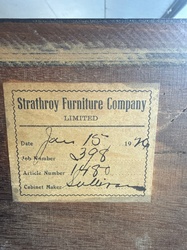
Authenticity: Based on visual examination, the style, construction, and decorative elements appear authentic to the period. However, without in-person inspection, I cannot verify wood species, joinery methods, or the precise age of the inlay work. Provenance documentation could help confirm its manufacturing origin, particularly the Grand Rapids association, and scientific testing (e.g., carbon dating for the wood) would offer definitive age verification.
Market Conditions and Comparables: The market for Victorian furniture, particularly rocking chairs, is somewhat subdued compared to earlier peaks. While well-preserved examples with unique features still command good prices, pieces with significant condition issues like this one trade at a discount. Comparable inlaid rocking chairs, sometimes attributed to Grand Rapids manufacturers, have sold in the range of $300-$600 in good condition.
Demand and Rarity: While not exceptionally rare, the inlay work adds a decorative appeal that separates it from more utilitarian rocking chairs. Demand is moderate, driven by collectors of antique furniture and individuals seeking period accent pieces. The need for restoration would be a significant factor for potential buyers.
Factors Impacting Value: The quality of the inlay and carving are positive attributes. However, the condition issues—specifically the finish loss on the seat and scuffing—are the primary depreciating factors. Restoration costs would need to be factored in by a potential buyer. Without physical examination, I cannot confirm the structural integrity of the joints, which could further impact value.