AI estimate as of September 19, 2025 · verify with a professional before acting
AI-Generated · Verify before acting
Everything on this page is generated by AI for informational purposes only. AI can make mistakes — the AI may misidentify items or misattribute them (artist, maker, brand, designer, origin, era). This is not an official valuation and should not be used for insurance, sale, tax, estate, legal, or lending purposes — or any decision requiring a certified appraisal. It is not an authoritative claim about any person, brand, or rights holder — do not share or rely on it as a factual statement about a third party. Always consult qualified professionals before making financial decisions.
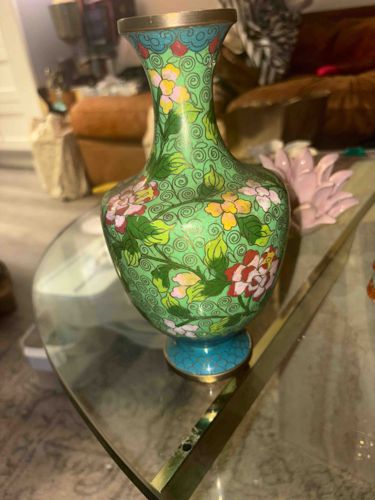
This item is a small, ornate cloisonné vase, characterized by its vibrant green background adorned with intricate floral and scroll patterns. The vase features a classic baluster shape, narrowing at the neck and base, and gently widening at the body. It stands on a distinct circular foot, which is enameled in a contrasting teal blue with a stylized scale or swirl pattern, bordered by a thin brass or gilded metal rim. The mouth of the vase also has a similar brass or gilded rim, suggesting a metallic base structure. The main body of the vase is primarily a medium to light green, extensively decorated with delicate floral motifs in shades of pink, white, yellow, and red, accented by green leaves. Intricate gold or brass wirework defines the outlines of all colors and patterns, a hallmark of the cloisonné technique, where thin metal strips are bent to form compartments which are then filled with enamel. A notable feature is the swirling scroll pattern in a darker green or black that fills the background spaces between the flowers, providing depth and texture. The neck of the vase displays a band of teal blue with a cloud or Ruyi head pattern, mirroring the base. The craftsmanship appears to be of good quality, with clear definition between the enamel colors and wirework, indicating careful application. There are no obvious visible condition issues such as chips, cracks, or significant loss of enamel, although closer inspection would be required to confirm this. The metallic rims show a slight patina consistent with age. This style of cloisonné, with its vibrant colors and detailed floral designs, is often associated with Asian artistry, particularly Chinese or Japanese, and could date from the late 19th to mid-20th century.
AI Appraisal Report
Upon visual examination of this cloisonné vase, I assess it to be a well-crafted decorative piece, likely of Chinese origin from the mid to late 20th century. My assessment is based on the baluster shape, vibrant color palette, and intricate floral and scroll motifs, which are characteristic of this period. The wirework appears consistent and clearly defined, and the enamel shows good color saturation. From the provided images, the vase appears to be in very good condition with no visible cracks, chips, or significant enamel loss. The slight patina on the gilded metal rims is consistent with its probable age.
The market for 20th-century Chinese cloisonné is generally stable, though heavily populated. Pieces of this size and quality, without a specific maker's mark or exceptional historical provenance, are fairly common. Comparables from recent auctions and online marketplaces for similar mid-century cloisonné vases of this size and condition typically sell in the $150 to $250 range. The value is primarily driven by its decorative appeal rather than rarity.
It is crucial to note the limitations of an appraisal based solely on images. Full authentication is not possible. An in-person examination would be required to inspect for subtle repairs, check for a maker's mark on the underside of the base, and assess the true quality of the metal and enamel. Without provenance documentation or a confirmed reign mark (e.g., Qianlong or Jingtai marks, which are often copied), its origin is presumed to be for decorative export rather than a piece from an earlier, more valuable period. Therefore, this valuation assumes it is a 20th-century decorative item.