AI estimate as of July 29, 2025 · verify with a professional before acting
AI-Generated · Verify before acting
Everything on this page is generated by AI for informational purposes only. AI can make mistakes — the AI may misidentify items or misattribute them (artist, maker, brand, designer, origin, era). This is not an official valuation and should not be used for insurance, sale, tax, estate, legal, or lending purposes — or any decision requiring a certified appraisal. It is not an authoritative claim about any person, brand, or rights holder — do not share or rely on it as a factual statement about a third party. Always consult qualified professionals before making financial decisions.
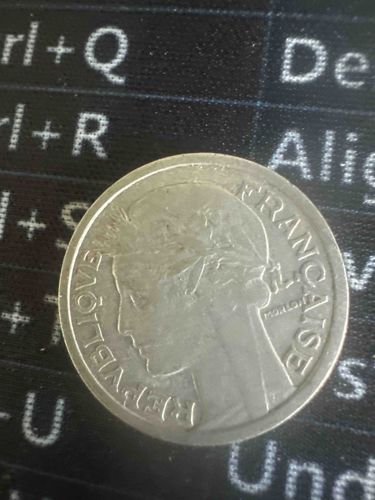
The item is a silver-toned coin, likely made from a nickel or similar alloy, given its appearance and the common materials for French circulating coinage of that era. Its exact size cannot be determined without a reference, but it appears to be a standard circulating coin. The obverse features a left-facing profile of a woman, which is a common allegorical representation of Marianne, the national personification of the French Republic. Her hair appears styled, possibly with a Phrygian cap or a similar head covering implied by the shape of her head. Around the effigy, the inscription "REPUBLIQUE FRANÇAISE" is clearly visible, wrapping along the upper and lower edges of the coin. Below Marianne's chin, the engraver's signature "MORLON" is subtly present, indicating the work of Pierre-Alexandre Morlon, a renowned French medalist and sculptor. The surface of the coin shows signs of circulation, with some light scratches and dulling of the luster, consistent with a used but not heavily damaged piece. There is a slight patina visible, hinting at its age. The edges appear smooth, but a reeded edge cannot be confirmed from this single view. No significant dents, deep gouges, or signs of major damage are apparent, suggesting it is in good, circulated condition. Based on the inscription and the artist's signature, this coin is a French franc, likely from the mid-20th century, specifically the period when Morlon's designs were in use for French coinage (e.g., the Morlon series). Its overall craftsmanship is precise, reflecting official government minting standards.
AI Appraisal Report
I have carefully examined the provided image of the French 'Morlon' Franc Coin (Obverse). Based on its visual characteristics, I assess this coin to be authentic, consistent with the designs of Pierre-Alexandre Morlon, a renowned French medalist and sculptor whose signature 'MORLON' is visible below Marianne’s chin. The inscription 'REPUBLIQUE FRANÇAISE' is clear and correctly positioned.
The coin's condition appears to be 'Good, Circulated'. While a precise grade without physical inspection is impossible, I note light scratches and dulling of the luster, consistent with a coin that has seen active circulation but no major damage such as deep gouges or significant rim nicks. A slight patina suggests age but does not detract significantly from its visual appeal. The base metal appears to be nickel or a similar alloy, appropriate for French circulating coinage of the mid-20th century 'Morlon' series.
From a market perspective, French Morlon francs are relatively common, particularly those made from base metals. While appreciated for their artistic merit, they typically do not command high values unless in uncirculated (UNC) or exceptionally high-grade conditions. This coin, being circulated, would fall into the lower to mid-range of market values for its type. Demand is steady among collectors of modern French coinage, but rarity is low for circulating issues.
The primary factors impacting its value are its circulated condition and the commonality of the type. Without physical examination, I cannot confirm exact mintage year (which can impact value for some types), identify specific die varieties, or assess edge condition (e.g., reeded vs. plain). For full authentication and a definitive grade, a physical inspection is essential to verify weight, diameter, thickness, and composition, and to examine the reverse side. Provenance documentation could also add to its history, but for this common coin type, it's not a primary driver of value.
Considering these factors, particularly its circulated state and common availability, the appraisal value reflects its collectible interest rather than significant numismatic rarity.