AI estimate as of August 9, 2025 · verify with a professional before acting
AI-Generated · Verify before acting
Everything on this page is generated by AI for informational purposes only. AI can make mistakes — the AI may misidentify items or misattribute them (artist, maker, brand, designer, origin, era). This is not an official valuation and should not be used for insurance, sale, tax, estate, legal, or lending purposes — or any decision requiring a certified appraisal. It is not an authoritative claim about any person, brand, or rights holder — do not share or rely on it as a factual statement about a third party. Always consult qualified professionals before making financial decisions.
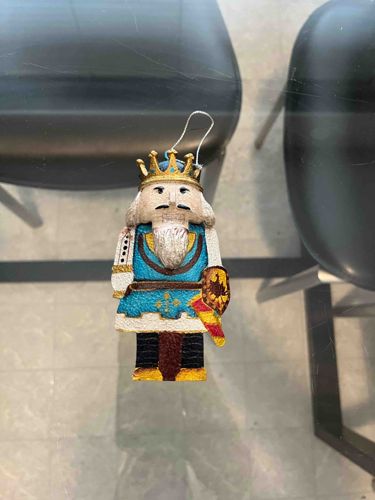
This item is a decorative holiday ornament, specifically a nutcracker-style figure depicted as a king. It appears to be made from a lightweight material, possibly wood or a resin composite, with detailed hand-painted elements. The figure is predominantly colored in shades of blue, white, gold, and red. The king wears a golden crown with blue accents, a white beard, and a light-colored complexion for his face. His attire includes a blue tunic with a decorative gold belt or sash, and white trim. The arms are indicated by the color changes on the sides, with what appears to be a red and yellow striped element held in the right hand, possibly a standard or flag, along with a small shield featuring a golden emblem on a reddish-brown background. The base or legs are dark brown with golden 'shoes' or feet. The overall construction suggests it is a flat or low-relief piece, designed to be hung, as indicated by the silver wire loop protruding from the top of the crown. The painting seems to have a slightly distressed or aged finish, although no significant damage like chips, cracks, or heavy wear is immediately apparent. The craftsmanship indicates a factory-produced item intended for holiday decoration, likely from the late 20th or early 21st century given its style and material. Its quality is consistent with mass-produced decorative ornaments.
AI Appraisal Report
Upon examining the provided image of this King Nutcracker Christmas Ornament, I assess its condition as very good. There are no visible chips, cracks, or significant paint loss, and the colors appear vibrant. The slightly distressed finish seems intentional, lending an aged aesthetic without indicating actual wear. Authenticity, based solely on visual inspection, points to a factory-produced holiday decorative item, likely dating from the late 20th or early 21st century. The style, materials (appearing to be wood or resin composite), and hand-painted elements are consistent with typical mass-produced ornaments of this type.
From a market perspective, comparable items—similar decorative themed ornaments, especially nutcrackers—are widely available, both new and pre-owned. The demand for such items is generally moderate, peaking during the holiday season. This specific ornament does not exhibit any characteristics typically associated with high rarity, such as artist signatures, limited editions, or historical significance. It is a retail-quality decorative piece, not a collectible antique.
Factors impacting its value include its good condition and aesthetic appeal as a holiday decoration. However, its mass-produced nature, lack of unique identifying marks, and common style significantly limit its potential market value as a collectible. Value is largely driven by its decorative utility rather than intrinsic rarity or craftsmanship.
Limitations in authenticity verification are inherent when relying on images alone. A physical examination would allow for tactile assessment of material, weight, and detailed inspection for manufacturing marks or signs of true age versus applied distressing. Provenance documentation (e.g., original packaging, purchase receipts) could confirm specific manufacturer or origin, but is unlikely to dramatically alter the appraisal for this type of item. Scientific testing is unnecessary for a modern decorative piece of this nature.