AI estimate as of October 18, 2025 · verify with a professional before acting
AI-Generated · Verify before acting
Everything on this page is generated by AI for informational purposes only. AI can make mistakes — the AI may misidentify items or misattribute them (artist, maker, brand, designer, origin, era). This is not an official valuation and should not be used for insurance, sale, tax, estate, legal, or lending purposes — or any decision requiring a certified appraisal. It is not an authoritative claim about any person, brand, or rights holder — do not share or rely on it as a factual statement about a third party. Always consult qualified professionals before making financial decisions.
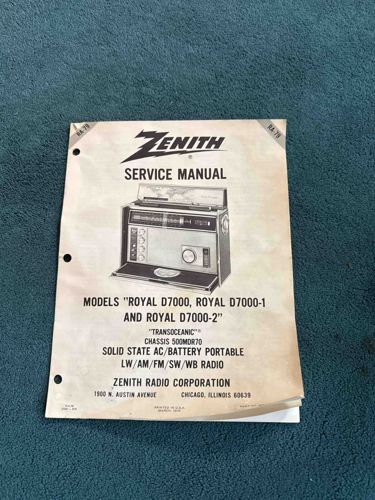
This item is a vintage Zenith 'Service Manual' for the 'Transoceanic' 'Royal D7000', 'Royal D7000-1', and 'Royal D7000-2' solid-state AC/battery portable radios. The manual is identified as pertaining to 'Chassis 500MDR70' and covers LW/AM/FM/SW/WB radio functionality. Physical characteristics include a white or off-white paper cover, standard letter or legal-sized pages, and three punched holes on the left margin, indicating it was likely designed to be stored in a three-ring binder. The Zenith logo is prominently displayed at the top, followed by 'SERVICE MANUAL' in bold text. Below this, an illustration of the portable radio model is visible, providing a visual reference for the electronics technician or owner. The manual was published by 'ZENITH RADIO CORPORATION' located at '1900 N. Austin Avenue, Chicago, Illinois 60638'. A small marking 'RA-79' is visible on the upper right corner, likely an internal catalog or revision number. The printing date, although partially obscured, appears to be 'March 1970', placing its estimated age in the early 1970s. The paper shows signs of age, including yellowing, some creases, and minor grime or discoloration, consistent with a utilitarian document of this age. There are no significant tears or missing pages visible. This manual is a crucial reference for repair, maintenance, and understanding the circuitry of these specific Zenith radio models, indicating its value to collectors, restoration enthusiasts, and historical preservationists of vintage electronics.
AI Appraisal Report
Based on my visual examination of the provided image, I assess this Zenith 'Transoceanic' Royal D7000 Series Service Manual to be in good, utilitarian condition for its age. Authenticity is strongly suggested by the prominent Zenith branding, the specific model numbers (D7000, D7000-1, D7000-2), chassis number (500MDR70), and the corporate address, all consistent with Zenith publications of the era. The ‘RA-79’ marking and the visible date, 'March 1970,' further cement its authenticity as an original service document from the early 1970s. The yellowing, minor creases, and slight grime are typical signs of age and use for a paper service manual, indicating it was likely used for its intended purpose. There are no major rips or missing pages apparent, which is a positive factor.
In terms of market conditions, vintage electronics service manuals, particularly for iconic models like the Zenith Transoceanic series, have a niche but consistent demand. Collectors, restorers, and hobbyists seek these for repair, restoration, and historical reference. Comparables on online marketplaces typically range from $20 to $60 depending on condition, completeness, and the specific model covered. While Transoceanic radios are highly collectible, their service manuals are generally less rare than the radios themselves. This particular manual covers a solid-state model, which sometimes garners slightly less interest than the earlier tube-based Transoceanics, but is still valuable.
The primary factor impacting value here is its good, although not pristine, condition, and its specific utility for a sought-after vintage radio series. Its completeness (no apparent missing pages) is also a strong point. Demand is steady among a focused group, contributing to its stable, albeit modest, value.
Limitations in authenticity verification from images alone exist. While the visual cues are very strong, a full in-person examination would allow me to physically inspect the paper quality, printing methods, and binding for complete confirmation against known genuine examples. I could also check for any hidden marks, watermarks, or repairs not visible in the image. Provenance documentation (e.g., if it came directly from an old repair shop or family collection) would also add certainty, although it’s less critical for such a utilitarian item than it would be for a fine art piece.