AI estimate as of September 17, 2025 · verify with a professional before acting
AI-Generated · Verify before acting
Everything on this page is generated by AI for informational purposes only. AI can make mistakes — the AI may misidentify items or misattribute them (artist, maker, brand, designer, origin, era). This is not an official valuation and should not be used for insurance, sale, tax, estate, legal, or lending purposes — or any decision requiring a certified appraisal. It is not an authoritative claim about any person, brand, or rights holder — do not share or rely on it as a factual statement about a third party. Always consult qualified professionals before making financial decisions.
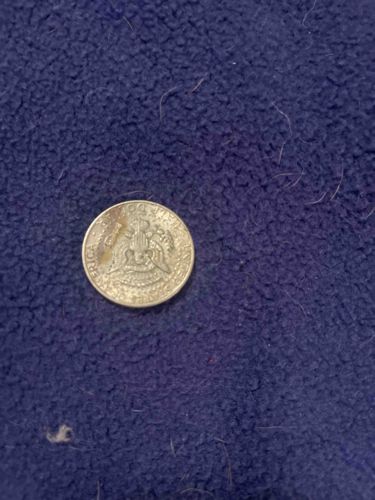
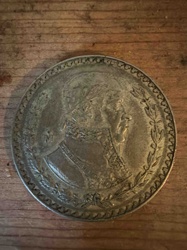
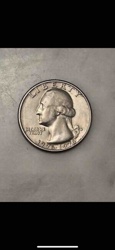
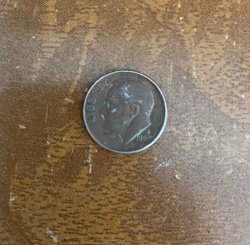
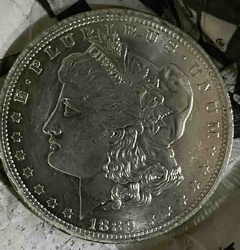
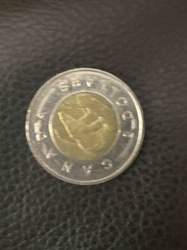
The item is a silver-colored metallic coin, appearing to be a United States half dollar, specifically the reverse side featuring the Great Seal of the United States. The coin is circular and relatively flat, consistent with standard currency. The primary visible motif is an eagle with outstretched wings, clutching an olive branch in one talon and arrows in the other, with a shield on its chest. Above the eagle, within a cloud-like design, are stars, and the inscription 'E PLURIBUS UNUM' is partially visible. Around the upper periphery of the coin, the words 'UNITED STATES OF AMERICA' are clearly legible, while the denomination 'HALF DOLLAR' is partially visible at the bottom. The surface of the coin exhibits significant wear, particularly on the raised elements of the eagle and the surrounding inscriptions, suggesting prolonged circulation. There are areas of discoloration and what appears to be a light patina, consistent with age and environmental exposure. The overall condition is fair to good, but details are softened due to wear. No specific mint mark or date is discernible from the provided image, which would typically be on the obverse side. The quality of the strike, based on the visible details, appears to be standard for circulating coinage. It is difficult to ascertain the exact material without closer inspection, but its color suggests a silver alloy or a clad composition typical of US half dollars. The coin is resting on a dark blue, possibly fleece or carpeted, surface, which has some light-colored fibers or lint visible.
AI Appraisal Report
I have examined the provided image of what appears to be the reverse of a United States Half Dollar Coin. Based on the iconography of the Great Seal of the United States, specifically the eagle with shield, olive branch, and arrows, and the partial inscriptions 'UNITED STATES OF AMERICA' and 'HALF DOLLAR', this is unequivocally a US half dollar coin. Its silver color suggests either 90% silver composition (pre-1965), 40% silver clad (1965-1970), or a copper-nickel clad composition (1971-present). Without seeing the obverse or a date, and given the significant wear, definitive material classification is limited to visual inference.
The coin exhibits considerable wear, particularly on the highest points of the eagle's feathers, shield, and the 'E PLURIBUS UNUM' scroll, softening details significantly. This places its condition in the 'Good' to 'Very Good' range according to numismatic grading standards. There are also signs of discoloration and a light patina consistent with age and circulation. The strike appears standard for circulating coinage of its era. Authenticity, based purely on visual elements from the reverse, seems likely for an actual coin, but images alone cannot rule out high-quality counterfeits or alterations; a physical inspection is crucial for full authentication.
Market conditions for common date, heavily circulated half dollars are generally low, primarily driven by their melt value if silver, or face value if clad. Demand for such a piece in this condition, without a discernible date or specific rarity, is minimal among serious collectors. Its value is largely tied to its metal content.
To fully authenticate and precisely value this coin, an in-person examination is essential to: 1) determine the date and mint mark (found on the obverse), 2) accurately assess its grade using professional numismatic tools, 3) confirm its metallic composition (e.g., specific gravity test for silver content), and 4) identify any hidden damages or alterations not visible in the image. Without knowing the date, specific type (e.g., Walking Liberty, Franklin, Kennedy), or silver content, the current appraisal is speculative. However, given the wear, it is highly unlikely to be a rare or key-date issue that would command a premium beyond its intrinsic value.